Billgami

Electrician invoice template

Last updated: July 2026

An electrician invoice template needs your business name and license number, the client and service address, an invoice number, itemized labor and materials, any permit fee, the total due, and clear payment terms. Download the filled electrician invoice example below in PDF or Word, or build the same invoice on your iPhone with Billgami.

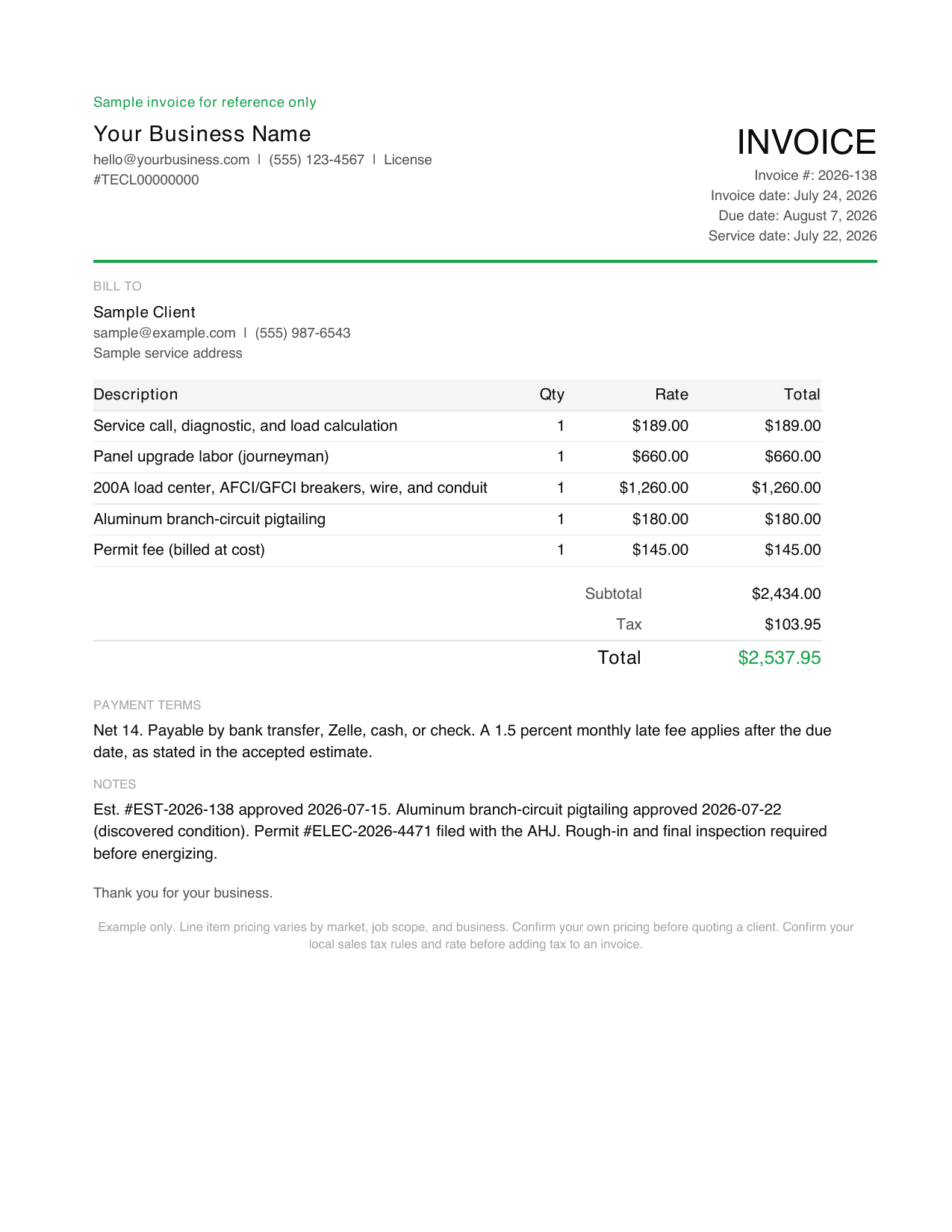
Preview of page 1 of the electrician invoice template with a realistic 2026 US 200A panel upgrade, code-required breakers, and permit line items

Download

What must be included

What must be included on an electrician invoice?

This is a filled electrician invoice example for a residential 200A panel upgrade, including the service call, code-required AFCI and GFCI breakers, a discovered condition that was approved before the work, the permit fee passed through at cost, and the deposit credited against the balance. It shows the electrician invoice format a homeowner and an inspector both expect to see. This same electrical invoice template works for a service call with a diagnostic, a rewire, or an EV charger install, and it shows how an electrician service call fee sits on the bill, and the same layout doubles as an electrician quote template or an electrician work order template when you change the heading. If you searched for an electrical contractor invoice template, an electrical service invoice template, an electrician receipt template, or the electrician invoice template Word file, they are all the same document below in different formats. The Word version opens in Microsoft Word, Google Docs, or Pages if you would rather edit before you export a PDF. Numbers are illustrative benchmarks. Your actual pricing depends on your market, your license level, and the job.

Invoice

Sample electrician invoice (with real numbers)

Invoice #

2026-138

From

Your Business Name

hello@yourbusiness.com
(555) 123-4567
License #TECL00000000

Bill to

Sample Client

sample@example.com
(555) 987-6543
Sample service address

DescriptionQtyRateTaxTotal

Service call, diagnostic, and load calculation

Trip charge plus panel load calc to size the upgrade

1$189.00N$189.00

Panel upgrade labor (journeyman)

Remove 100A panel, install 200A service, terminate circuits

1$660.00N$660.00

200A load center, AFCI/GFCI breakers, wire, and conduit

AFCI/GFCI breakers are code-required, not optional

1$1,260.00Y$1,260.00

Aluminum branch-circuit pigtailing (discovered, approved)

Client approved 2026-07-22 after the condition was found

1$180.00N$180.00

Permit fee (billed at cost, pass-through)

Paid to the AHJ, no markup, receipt attached

1$145.00N$145.00

Deposit received at scheduling

Applied against the balance due

1-$900.00-$900.00
Subtotal$1,534.00
Tax$103.95 (illustrative 8.25 percent on taxable materials only; labor and permit fees untaxed in this example; confirm your local rule)
Total$1,637.95

Payment terms

Net 14. Payable by bank transfer, Zelle, cash, or check. A 40 percent deposit was collected at scheduling and is credited above. A 1.5 percent monthly late fee applies after the due date, as stated in the accepted estimate.

Example only. Rates vary by region, license level, and job. Confirm your own pricing before quoting, and confirm your state sales tax rules before adding tax to an invoice. Nothing here states that any specific work satisfies the electrical code or will pass inspection.

What goes where

  • 1

    From block with license number

    Your business name, contact details, and your license number. Texas, California, and Florida all require the license or registration number on business documents, and many inspectors and homeowners will not treat an invoice as legitimate without it.

  • 2

    Bill to and service address

    The customer's name and the address where the work happened. For rental and property-manager jobs the service address is often not the billing address, so show both.

  • 3

    Invoice and permit number

    A unique invoice number, plus the permit number when the job was permitted. Tying the invoice to the permit is what lets a customer match your bill to the inspection record.

  • 4

    Service call and diagnostic

    The trip charge and diagnostic, on its own line. Say on the estimate whether it credits toward the job if they proceed, so there is no argument later.

  • 5

    Code-required materials

    AFCI and GFCI breakers are required by the electrical code on a panel upgrade, not an upsell. Keeping them on their own labeled line is how you show the customer they were not optional.

  • 6

    Discovered condition

    The aluminum pigtailing was found during the work and approved before it was done. It is billed as its own line with the approval date referenced, never folded into the panel labor.

  • 7

    Permit fee pass-through

    The permit fee is paid to the authority having jurisdiction and rebilled at cost with no markup. A government pass-through is not your taxable revenue, so keep it off the taxed subtotal.

  • 8

    Deposit credit and terms

    The deposit paid at scheduling is credited as its own negative line, so the total job value and the balance due are both visible. Net 14 with a due date and accepted methods closes the invoice.

Scope decision matrix

Why is this on my bill? Code-required versus what you asked for

The most common electrician invoice dispute is not the price, it is the customer seeing a charge for work they never requested. On a panel swap the code often requires AFCI and GFCI breakers, updated grounding, and a service disconnect the customer never mentioned. The fix is to settle one question before the work, then put the code-required item on its own labeled line with a matching exclusion, so the invoice reads as a record instead of a surprise.

Client requestClarification to askLine item on the invoiceExclusion to state
Replace my electrical panelDoes the existing branch wiring meet the code your inspector enforces today?Panel plus AFCI and GFCI breakers as separate labeled linesExcludes rewiring of any circuit found non-compliant, quoted separately
Add one outlet in the garageIs the circuit you want to tap already at capacity?Outlet, plus a new dedicated circuit as its own line if neededExcludes a panel capacity upgrade if the panel is full
Install an EV chargerDoes the service have spare capacity for a 40 to 60 amp circuit?Charger circuit and load calculation as its own lineExcludes a service upgrade if the load calc requires one
Replace this ceiling fixtureIs the existing box rated for the weight of the new fixture?Fixture, plus a fan-rated box replacement itemized separatelyExcludes drywall or ceiling repair around the box
My outlet stopped working, just fix itIs this one device or a tripped protective device upstream?Diagnostic first, then the repair as a separate line once foundExcludes replacing devices that test fine on the same circuit
Estimate to invoice

How do you reconcile the estimate against the final invoice?

The estimate is what the customer approved. The invoice is what the job actually took. On electrical work the difference is almost always a discovered condition, something hidden behind the panel or in the wall that has to be corrected before the new work is safe and code-compliant. This matrix shows the same job reconciled line by line, so the customer can see exactly where the $180.00 variance came from and that it was approved before it was done.

Scope itemQuotedActualDifferenceReason or approvalInvoice treatment
Service call, diagnostic, and load calculation1 call at $189.00$189.00$189.00$0.00As quotedBill as quoted; credit it toward the job total only if your estimate said you would
Panel upgrade labor (journeyman)1 job at $660.00$660.00$660.00$0.00As quotedBill as quoted; labor is not sales taxable in most states
200A load center, AFCI/GFCI breakers, wire, and conduit1 job at $1,260.00$1,260.00$1,260.00$0.00As quoted; AFCI/GFCI breakers are required by code, not an upsellBill as quoted; materials line, taxable where your state taxes materials
Aluminum branch-circuit pigtailing0 condition quoted, 1 actual at $180.00$0.00$180.00+$180.00Aluminum branch wiring was found behind the panel during the swap and had to be pigtailed to copper before the new breakers could land (approved 2026-07-22)Bill as a separate line with the approval date referenced, never folded into the panel labor
Permit fee (billed at cost)1 permit at $145.00$145.00$145.00$0.00Paid to the authority having jurisdiction, passed through at costBill at cost with the receipt attached; a government pass-through is not your taxable revenue
Totals$2,254.00$2,434.00+$180.00Plus $103.95 tax (illustrative 8.25 percent on taxable materials only; labor and permit fees are not taxed in this example, confirm your local rule) brings the total job value to $2,537.95. The invoice then credits the $900.00 deposit paid at scheduling, so the balance due on the sample invoice above is $1,637.95.

Discovered conditions: when you open a panel or a wall and find aluminum wiring, knob-and-tube, a double-tapped breaker, or no ground, stop and get approval before you correct it. Then bill it as its own line with the date the customer approved it. A text or email timestamp is enough documentation for most residential work.

Code-required additions: breakers, grounding, and disconnects the code requires are not upsells. Put each on its own labeled line so the customer can see it was required, not chosen, and reference the code cycle your jurisdiction enforces.

Permit and inspection fees: pass these through at cost with the receipt attached. A government fee is not your taxable revenue, so keep it out of the taxed materials subtotal.

Materials versus labor tax: most states tax materials and not labor, but the rule varies and some states tax neither on a capital improvement. Split the two on the invoice so the tax base is obvious and confirm your state rule before you set it.

Progress billing: on larger jobs tie each invoice to an inspection stage, rough-in and then final, so the customer is paying against verifiable milestones rather than a single lump sum at the end.

Step by step

How do you make an electrician invoice?

  1. 1

    Start from the approved estimate so the invoice matches what the customer agreed to.

  2. 2

    Itemize labor and materials on separate lines, and put code-required additions on their own labeled lines so nothing looks like a surprise upsell.

  3. 3

    Add the permit fee at cost and reference the permit number.

  4. 4

    Credit any deposit already paid as a separate negative line so the balance due is unambiguous.

  5. 5

    Add your license number, the invoice number, due date, and payment terms, then export a PDF and send it.

2026 benchmarks

How much do electricians charge in the US in 2026?

Illustrative 2026 US ranges for residential and light-commercial electrical work, billed by an independent electrician or a small shop. Hourly ranges are contractor bid rates, not wages, so they carry the truck, tools, insurance, licensing, and unbilled time. Flat-rate job prices bundle labor and typical materials. Use them as a starting benchmark, not a fixed price.

WorkTypical 2026 rangeHow it is usually billed
Standard service call$75 to $200Flat trip charge
Journeyman hourly$85 to $130Hourly
Panel upgrade to 200A$1,800 to $4,000Flat rate
EV charger install$500 to $2,200Flat rate plus load calc
Add a dedicated circuit$250 to $900Flat rate
WorkTypical 2026 rangeHow it is usually billed
Service calls and diagnostics
Standard service call$75 to $200Flat trip charge
Diagnostic or troubleshooting$100 to $350Flat or first hour
After-hours or emergency call$150 to $400 plusTrip charge at a multiplier
Hourly by license level
Apprentice (supervised)$40 to $75Hourly, on the crew rate
Journeyman$85 to $130Hourly
Master electrician$100 to $175Hourly or job rate
Common jobs (labor plus typical materials)
Panel upgrade to 200A$1,800 to $4,000Flat rate
EV charger install$500 to $2,200Flat rate plus load calc
Whole-home rewire$8,000 to $30,000By square foot or bid
Add a dedicated circuit$250 to $900Flat rate
Replace a fixture or fan$150 to $450Flat rate
Install or move an outlet$150 to $350Flat rate

How do you bill each type of electrical job?

Service call for a specific problem

Charge the trip and diagnostic up front, then the repair as its own line once you have found the fault. Say on the estimate whether the service call credits toward the repair if they proceed.

Flat-rate job with a known scope

Quote one price for a defined job like a panel upgrade or an EV charger, and keep code-required additions and discovered conditions on separate lines so the flat rate stays flat.

Time and materials on an open-ended job

Bill labor in dated blocks with the hours and rate visible, and materials at cost or with a disclosed markup. T and M only reads as fair when the customer can see what the hours bought.

Large job billed by inspection stage

Invoice at rough-in and again at final, tying each invoice to the inspection it follows. Progress billing against milestones beats one large bill at the end.

Emergency or after-hours call

Apply your after-hours multiplier to the trip charge and state it on the invoice. The customer agreed to emergency pricing when they called at 11pm; the invoice should reflect it plainly.

Deposit up front on a material-heavy job

Collect a deposit at scheduling to cover the panel or the charger, then credit it as a negative line on the final invoice so the total job value and the balance due are both visible.

How we sourced these 2026 rate ranges

The ranges above combine wage context from the US Bureau of Labor Statistics Occupational Employment and Wage Statistics, May 2024 release, SOC 47-2111 for electricians, with reported hourly pay from Indeed and public trade cost guides for the flat-rate jobs, all accessed July 2026. Hourly figures are presented as contractor bid rates rather than wages, because an electrician's rate has to carry the truck, tools, insurance, licensing, and the unbilled time between calls. bls.gov blocks automated requests, so the BLS figures are cited by series and release rather than by link. Treat every range as a starting benchmark for your market and license level, not a recommended price.

  • US Bureau of Labor Statistics, "Occupational Employment and Wage Statistics," May 2024 release, SOC 47-2111 (electricians). Accessed 2026-07-24.
  • Indeed, reported hourly pay for electricians, cross-checked against public trade cost guides. Accessed 2026-07-24.
  • Hourly ranges are contractor bid rates carrying truck, tools, insurance, licensing, and unbilled time; flat-rate job prices bundle labor and typical materials.
Official guidance

Which states require your license number on the invoice?

Electricians are licensed in every US state, and several make the license or registration number on business documents a legal requirement, not a courtesy. If you work in one of these states, your license number on the invoice is part of being compliant, and leaving it off is a reason an inspector or a customer can question the bill. Requirements differ, and these summaries are not legal advice.

Texas

License number required on invoices and contracts

Texas requires the electrical contractor's name, address, phone, and license number (prefixed TECL) on proposals, invoices, and written contracts. It is one of the few states that names invoices explicitly, which makes the license number on the bill a compliance item, not a preference.

Texas Department of Licensing and Regulation, electrician compliance guide

Summary only, not legal advice. Confirm the current rule for your jurisdiction before relying on it. Source verified 2026-07-24.

California

License number required on business documents

California requires a licensed contractor's number on contracts, business documents, and advertising. The Contractors State License Board can assess civil penalties from $100 to $5,000 for omitting it, so on an electrical invoice in California the number is not optional.

California CSLB Advertising Guidelines

Summary only, not legal advice. Confirm the current rule for your jurisdiction before relying on it. Source verified 2026-07-24.

Florida

Registration or certification number required in every offer of services

Florida statute 489.521 requires a registered or certified contractor's number to appear in every offer of services, business proposal, and advertisement. On a Florida electrical invoice, that means the certification or registration number belongs on the document.

Florida Statutes 489.521

Summary only, not legal advice. Confirm the current rule for your jurisdiction before relying on it. Source verified 2026-07-24.

Common mistakes

What are the most common electrician invoice mistakes?

Leaving the license number off the invoice

In Texas, California, and Florida the license or registration number on business documents is a legal requirement. Put it in your from block on every invoice, not just the contract.

Burying code-required work in the labor line

AFCI breakers, grounding, and disconnects the code requires belong on their own labeled lines. When a customer sees a lump labor charge they never approved, that is when the dispute starts.

Doing a discovered condition without written approval

When you find aluminum wiring or a missing ground, stop and get a text or email approval before you correct it. Then bill it as its own line with the approval date. Unapproved extras are the extras that do not get paid.

Marking up the permit fee

Pass permit and inspection fees through at cost with the receipt. Marking up a government fee looks bad on the invoice and can inflate the taxable subtotal it should never be part of.

Taxing labor because you tax materials

Most states tax materials and not labor, and some tax neither on a capital improvement. Split labor and materials on the invoice and confirm your state rule so the tax base is correct.

No permit number on a permitted job

If the job was permitted, put the permit number on the invoice. It is what lets the customer match your bill to the inspection record, and inspectors expect to see it.

One lump invoice on a multi-week job

Bill against inspection stages, rough-in and then final, so the customer pays against verifiable milestones instead of waiting for one large bill they can dispute all at once.

No late fee terms, then trying to add one

A late fee only holds if the customer accepted it before the work. Put it in the estimate, then restate it on the invoice. Adding one after the fact usually just delays payment further.

Template or app

Should you use a free electrician invoice template or an app?

NeedFree templateBillgami
Cost
Free
Free tier plus $249.99 lifetime option
Where you work
Desktop, Word or PDF editor
iPhone, in the truck or at the panel
Reusing customer details
Retype or copy the last file
Saved customers and reusable line items
License and permit numbers
You add them by hand each time
Kept in your business info and reused
Estimates and quotes
Separate document you maintain
Built in, alongside invoices
Paid, unpaid, partial tracking
A spreadsheet you maintain
Manual status tracking in app
PDF export
Export from Word each time
Built for PDF sharing from iPhone
Scheduling and dispatch
Not included
Not included; Billgami is invoices and estimates only
Payment processing
Not included
Not included; customers pay you directly

Prefer a full field-service suite? Pick ServiceTitan or Housecall Pro if you need scheduling, dispatch, and a technician fleet. For a licensed electrician who needs professional PDF invoices and estimates from a phone, both are more than the job requires.

Billgami for electricians

Send the same electrician invoice from your phone in about a minute

  • Save the customer and your common labor and material lines once, reuse them on the next call
  • Keep your license number in your business info so it lands on every invoice
  • Build the estimate and the invoice in one place, so the invoice matches what was approved
  • Preview the PDF and share it before you leave the panel
Getting paid

When should you send an electrician invoice, and how do you get paid?

When to send it

SituationSend it
Service call or small repairBefore you leave the property, from your phone, while the customer is there
Flat-rate job like a panel or chargerThe day the work passes final inspection
Large job billed by stageAt each inspection milestone, rough-in and then final
Time and materials jobWeekly or at agreed checkpoints, so the hours are still verifiable
New-construction or GC workOn the general contractor's billing cycle, referencing the draw
Emergency callOn the spot, with the after-hours rate stated on the invoice

How you get paid

Homeowners usually pay on receipt or within a few days. General contractors and property managers often run Net 30. Decide before you send, not after they are late.

Common payment methods

Bank transferZelleCheckCash
  • Billgami does not process payments. The customer pays you directly by the method you list, and you mark the invoice paid when the money arrives.
  • Take a deposit at scheduling on any job with a panel, a charger, or heavy materials, so you are not floating the parts.
  • Follow up the day after the due date with a short message that references the invoice and permit number.
  • Keep the PDF of every invoice you send; on a permitted job it is part of the record if the work is ever questioned.
Document practices

How do permits, inspections, and tax credits change the invoice?

Electrical work is gated by government inspection in a way most trades are not, and customers often ask about tax credits at the same time. Both belong on or near the invoice. This is general information, not tax or legal advice.

Permit number and inspection stages

When a job is permitted, put the permit number on the invoice and, on larger jobs, bill against inspection stages rather than one lump sum. Rough-in inspection covers wiring in the walls before they close; final inspection covers the finished, energized system. Tie each progress invoice to the stage it covers so the customer is paying against a verifiable milestone.

  • Reference the permit number so the invoice matches the inspection record.
  • Bill rough-in and final as separate stages on a large job.
  • If a re-inspection is needed, state plainly who caused it: a contractor-caused correction is on you, a customer-caused delay or change is billable.
  • Billgami records the invoice; it does not file permits, schedule inspections, or track code compliance.

Federal tax credits in 2026: both expired

Customers still ask whether panel and EV charger work qualifies for a federal credit. As of 2026 both are gone. The 30C EV charger credit expired June 30, 2026 under the One Big Beautiful Bill Act, and the 25C home improvement credit, which covered panelboards rated 200 amps or more that meet the National Electrical Code with a $600 per-item limit, applied only to property placed in service before December 31, 2025. What you can still do for a customer is give them a clean, itemized invoice that serves as placed-in-service documentation if their work finished before the deadline, and point them to state and utility rebate programs, which still exist in many areas.

  • 30C EV charger credit: expired June 30, 2026 (placed-in-service test).
  • 25C panelboard credit: 200A or more, $600 per-item limit, placed in service before December 31, 2025.
  • The invoice is the placed-in-service record; the credit is claimed by the customer on their own return.
  • This is general information, not tax advice. The customer should confirm eligibility with their tax preparer.

FAQ

What do electricians ask about invoice templates?

Clear answers on invoice templates, pricing, and how solo service pros send professional PDFs from a phone.

What should an electrician invoice include?

An electrician invoice needs your business name and license number, the customer name and service address, a unique invoice number and date, the permit number when the job was permitted, itemized labor and materials on separate lines, any code-required additions as their own labeled lines, any permit fee at cost, any deposit credited, the total due, and your payment terms.

Does an electrician invoice need a license number?

In several states, yes. Texas, California, and Florida all require the contractor's license or registration number on business documents, and Texas names invoices explicitly. Even where it is not strictly required, putting your license number on the invoice is what makes it read as legitimate to a homeowner or an inspector. Keep it in your from block on every invoice.

Why did my electrician charge me for breakers I did not ask for?

On a panel upgrade the electrical code usually requires AFCI and GFCI breakers, updated grounding, and sometimes a service disconnect, whether or not you asked for them. A good electrician itemizes these as their own labeled lines so you can see they were required by code, not chosen as an upsell. If they are buried in a lump labor charge, ask for them to be broken out.

What is an electrician service call fee?

An electrician service call fee is the flat charge for coming to your property and diagnosing the problem, before any repair. It typically runs $75 to $200 for a standard call and more for after-hours or emergency visits, and it usually covers the trip plus the first diagnostic. A good electrician tells you on the estimate whether the service call fee credits toward the repair if you go ahead, so it is not charged twice. On the sample invoice above it is the first line.

How much do electricians charge in 2026?

It depends on license level and region. As a benchmark, service calls run $75 to $200, journeyman labor $85 to $130 an hour, a 200A panel upgrade $1,800 to $4,000, and an EV charger install $500 to $2,200. These are contractor bid rates and flat-rate job prices, not wages, so they carry the truck, tools, insurance, and licensing.

How do I bill for a discovered condition?

Stop when you find it, get a text or email approval before you correct it, then bill it as its own line on the invoice with the approval date referenced. The sample above shows this: aluminum wiring found behind the panel was pigtailed to copper and billed as a separate $180.00 line, approved 2026-07-22, never folded into the panel labor.

Do I charge sales tax on an electrician invoice?

Usually on materials and not on labor, but it varies by state, and some states tax neither on a capital improvement. Split labor and materials on the invoice so the tax base is obvious, keep permit fees out of the taxed subtotal because a government pass-through is not your revenue, and confirm your own state rule before you set it.

Should I put the permit number on the invoice?

Yes, when the job was permitted. The permit number is what lets a customer match your invoice to the inspection record, and inspectors expect to see it. On larger jobs, bill against inspection stages, rough-in and then final, and reference the stage each invoice covers.

Does Billgami track permits, inspections, or code compliance?

No. Billgami creates the invoice document, saves your customers and reusable line items, and lets you export and manually track it. It does not file permits, schedule inspections, dispatch technicians, process payments, or determine whether work meets code. For those you use your licensing board, your AHJ, and a dedicated field-service tool if you need one.

Is Billgami full accounting software?

No. Billgami is for invoices, estimates, quotes, receipts, PDF records, and manual status tracking. It is not tax, payroll, bookkeeping, or payment processing software.

Can I send PDFs from my iPhone?

Yes. Billgami is built around creating professional PDFs and sharing them through the iPhone share sheet or email workflows you already use.

Last updated: July 24, 2026

Phuc Doan

Founder, Billgami·Last updated July 24, 2026

MethodologyEvery number on this page comes from the same JSON file that generates the downloadable PDF, Word, and Excel files, so the sample invoice you read and the file you download cannot drift apart. Licensing and tax summaries cite primary government sources with the date each was verified.

This page is general information, not legal or tax advice, and nothing here states that any specific work satisfies the electrical code or will pass inspection. Licensing rules, tax treatment, and code requirements vary by jurisdiction and change over time. Confirm the current rules for your situation with your licensing board and a qualified professional.

Send your next electrician invoice from your phone

Take the electrician invoice template PDF for a file you can send today, take the Word version if you would rather edit it first, or build the same electrical invoice format in Billgami and keep your license number, customers, and PDF records in one place. Billgami helps licensed electricians and small shops send professional invoices from iPhone without a full field-service suite.

Last updated: July 24, 2026 | Written by Phuc Doan

Billgami invoice history with paid, unpaid, and partial status on iPhone