Billgami

Plumbing Invoice Template

Last updated: July 2026

A plumbing invoice needs your business details, the customer and service address, the job date, itemized labor and parts, any permit billed at cost, sales tax where your state applies it, the total due, and payment terms. Download the free plumbing invoice PDF or Word template below, see a filled water heater sample with 2026 US rates, or send one from your phone in Billgami.

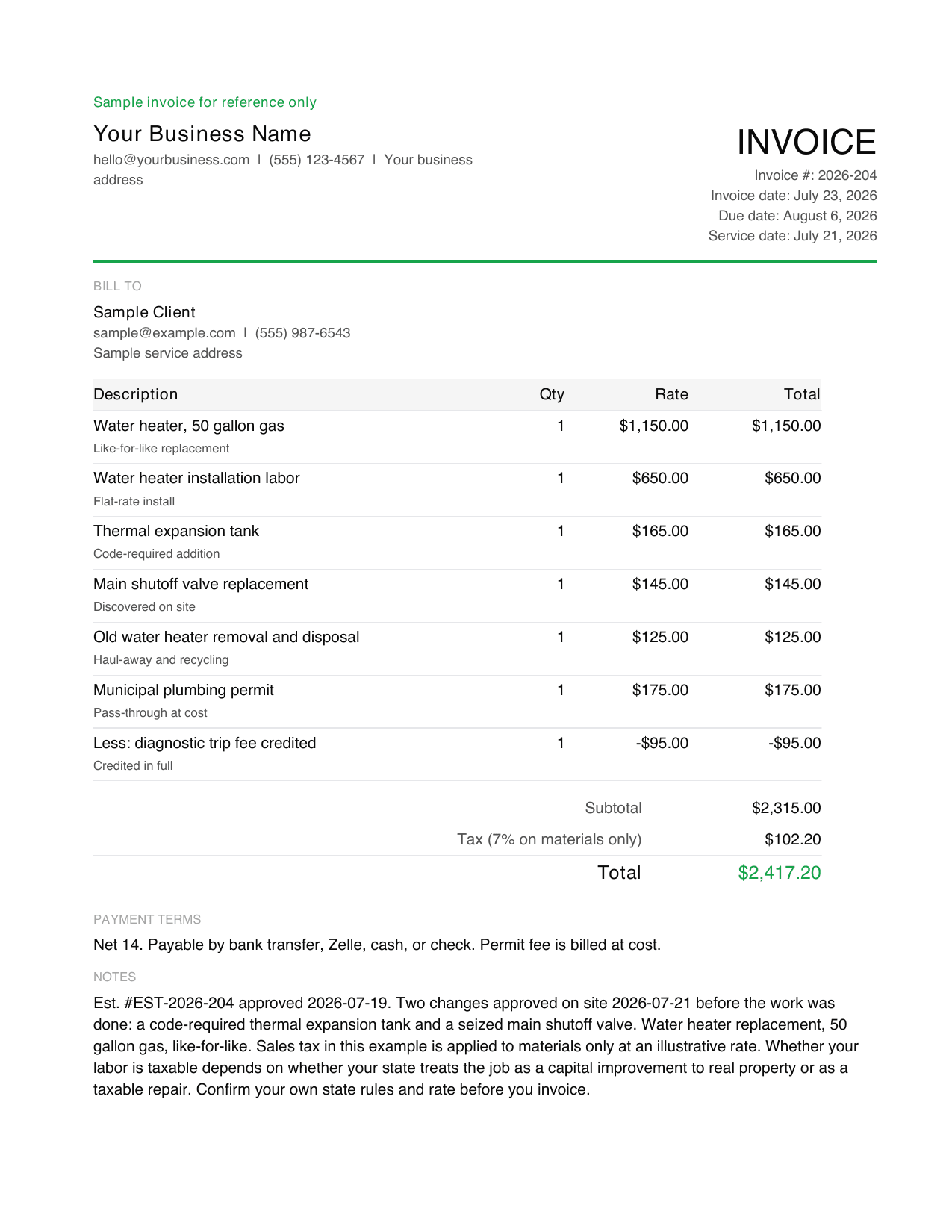
Preview of page 1 of the plumbing invoice template with a filled water heater replacement sample

Download

What must be included

What must be included on a plumbing invoice?

Every required field, labeled on a real plumbing invoice example with a water heater replacement, two changes approved on site, a permit billed at cost, and a trip fee credited back.

Invoice

Sample plumbing invoice (with real numbers)

Invoice #

2026-204

From

Your Business Name

Your business address
hello@yourbusiness.com
(555) 123-4567

Bill to

Sample Client

Sample service address
sample@example.com

DescriptionQtyRateTaxTotal

Water heater, 50 gallon gas

Like-for-like replacement unit, supplied and installed

1$1,150.00Y$1,150.00

Water heater installation labor

Flat-rate install: disconnect, set, connect gas and water, vent, fill, test

1$650.00N$650.00

Thermal expansion tank

Required by local code on a closed system. Approved on site before install.

1$165.00Y$165.00

Main shutoff valve replacement

Existing valve seized and would not close. Approved on site before install.

1$145.00Y$145.00

Old water heater removal and disposal

Haul-away and recycling of the replaced unit

1$125.00N$125.00

Municipal plumbing permit

Billed at cost as a pass-through. Amount varies widely by jurisdiction.

1$175.00N$175.00

Less: diagnostic trip fee credited

Trip fee charged at the first visit and credited in full against the repair

1-$95.00N-$95.00
Subtotal$2,315.00
Tax$102.20 (illustrative 7% on materials only)
Total$2,417.20

Payment terms

Net 14. Payable by bank transfer, Zelle, cash, or check. Permit fee is billed at cost.

Example only. Line item pricing varies by market, job scope, and business. Confirm your own pricing before quoting a client. Whether your labor is taxable depends on your state and on whether the job is treated as a capital improvement to real property or as a taxable repair. Confirm your state rules and rate before adding tax. This is not legal or tax advice.

What goes where

  • 1

    Business info and license number

    Your legal or trade name, license number, phone, email, and address at the top. Many states require the license number on customer paperwork, and it makes the invoice easy to identify and pay.

  • 2

    Customer and service address

    The customer's name, billing contact, and the address where you actually worked. On rentals and property management jobs these are often different, and the wrong one delays payment.

  • 3

    Job date and invoice number

    The date you did the work, a unique invoice number, and a pointer to the approved estimate so the customer can match the two documents.

  • 4

    Labor separated from parts

    Your time on one line and materials on their own. This matters more in plumbing than most trades, because several states tax parts and labor differently.

  • 5

    Changes approved on site

    The expansion tank and the shutoff valve are separate dated lines with a reason, not a silent increase to the quoted price. Photograph a failed part before you replace it.

  • 6

    Permit at cost

    Show the permit as a pass-through at cost so the customer can see it is not marked up. Permit fees vary widely by jurisdiction.

  • 7

    Trip fee credited

    If you charged a diagnostic or trip fee at the first visit and agreed to apply it to the repair, show it as a credit line rather than quietly reducing another number.

  • 8

    Total due and payment terms

    Subtotal, sales tax if it applies to your work, then the due date and how to pay. Billgami does not collect payments in-app, so name the method the customer should use.

Scope decision matrix

How do you turn a vague plumbing call into an invoice line?

Most plumbing disputes start at the phone call, not at the invoice. The customer describes a symptom, you price the symptom, and then the actual cause turns out to be something else. The questions below turn a vague description into a line item you can defend, plus the exclusion that protects you when the real cause is behind a wall. Ask them before you quote, and write the exclusion into the estimate so the invoice is not the first time the customer sees it.

Client requestClarification to askLine item on the invoiceExclusion to state
"My water heater is leaking."Is water coming from the tank itself, or from a fitting, valve, or the pan?Diagnostic visit, then either tank replacement or fitting repair as a separate quoted lineExcludes drywall, flooring, or water damage remediation of any kind.
"Just snake the drain."How many fixtures back up, and has it happened before this year?Drain clearing, single fixture, up to a stated cable lengthExcludes root intrusion, collapsed line, and any work needing a camera inspection or excavation.
"The toilet keeps running."Does it refill on its own, or only after a flush, and how old is the toilet?Fill valve and flapper replacement, parts and laborExcludes a cracked tank, a failed wax ring, or replacing the toilet itself.
"There's low water pressure everywhere."Hot side, cold side, or both, and did it drop suddenly or over months?Pressure diagnostic, then regulator replacement or line assessment as a separate lineExcludes repiping, municipal supply issues, and well or pump equipment.
"Can you look at the other bathroom while you're here?"Is that a second job today, or a quote for a return visit?Additional fixture inspection, billed at the hourly rate on the same visitExcludes any repair to that fixture until it is separately quoted and approved.
"It's an emergency, can you come now?"Is the water shut off, and can this hold until standard hours?After-hours call-out fee plus the after-hours labor rate, both stated up frontExcludes standard-hours pricing on any work performed during the call-out window.
"I already bought the parts."Which brand and model, and where did you buy them?Installation labor only, customer-supplied parts noted on the invoiceExcludes any warranty on the customer-supplied part, and excludes return trips caused by that part failing.
"How much to replace the water heater?"Same fuel and same size, and is the existing shutoff valve working?Flat-rate water heater replacement, unit and labor, with permit at costExcludes a code-required expansion tank, venting changes, and any valve or connector that fails on removal.
Estimate to invoice

What changed between the quote and the final plumbing invoice?

Plumbing jobs change once the panel comes off or the old unit comes out. This is the approved estimate for the water heater job above, reconciled line by line against what was actually installed, with the diagnostic trip fee credited at the bottom so the balance due is the number the customer pays. Two lines were quoted at zero because nobody could see them at the quoting visit: a thermal expansion tank that local code requires on a closed system, and a main shutoff valve that had seized. Both were approved on site before the work was done. Every figure comes from the same source file that builds the downloadable PDF and the Excel change log.

Scope itemQuotedActualDifferenceReason or approvalInvoice treatment
Water heater, 50 gallon gas1 unit at $1,150.00$1,150.00$1,150.00$0.00As quotedBill as quoted. Materials, so sales tax applies in this example
Water heater installation labor1 job at $650.00$650.00$650.00$0.00As quotedBill as quoted. Whether labor is taxable depends on your state
Thermal expansion tank0 unit quoted, 1 actual at $165.00$0.00$165.00+$165.00Local code requires an expansion tank on a closed system. Not visible at the quoting visitAdd as a new approved line with the date the customer agreed
Main shutoff valve replacement0 valve quoted, 1 actual at $145.00$0.00$145.00+$145.00Existing valve seized and would not close, so the new heater could not be connected safelyAdd as a new approved line. Photograph the failed part before replacing it
Old water heater removal and disposal1 job at $125.00$125.00$125.00$0.00As quotedBill as quoted
Municipal plumbing permit1 permit at $175.00$175.00$175.00$0.00As quotedShow as a pass-through at cost so the customer can see it is not marked up
Less: diagnostic trip fee credited1 credit at -$95.00-$95.00-$95.00$0.00Trip fee was charged at the first visit and credited in full once the repair was bookedShow as a credit line so the balance due is what the customer actually pays
Totals$2,005.00$2,315.00+$310.00Plus $102.20 tax (illustrative 7 percent on materials only; confirm your local rules and rate) brings the final invoice to $2,417.20.

Get approval before the extra work happens, even if it is a text message from the driveway. Note the date on the invoice line so the customer can match it to the conversation.

Photograph the failed part before you replace it. A seized shutoff valve is obvious to you and invisible to a customer reading an invoice three days later.

A code requirement is not an upsell, but it will read like one if it appears as a bare line. Say which code and why the job could not be finished without it.

Bill approved additions at the rate already in the estimate. Changing your rate mid-job is what turns a small addition into a dispute.

Keep the trip fee as its own credit line rather than quietly reducing another number. The customer should see the full value of the work and the amount already paid.

Billgami has no formal change-order document type. Approved changes are represented as revised line items plus an invoice note that references the original estimate.

Step by step

How do you make a plumbing invoice?

  1. 1

    Fill in your business details, license number, the customer, the service address, the job date, and a unique invoice number that references the approved estimate.

  2. 2

    Itemize labor and parts on separate lines. If you quoted a flat rate, show the flat rate as one line rather than reverse-engineering an hourly figure.

  3. 3

    Add anything approved on site as its own dated line, with a short reason. A code-required expansion tank and a seized shutoff valve are separate lines, not a silent increase to the original quote.

  4. 4

    Show the permit at cost and credit any trip or diagnostic fee you agreed to apply to the repair.

  5. 5

    Apply sales tax only where your state says it applies, state the payment terms and due date, then export as PDF and send it.

2026 pricing data

How much do plumbers charge in the US in 2026?

Typical prices charged by plumbing pros in the US in 2026, drawn from published pricing data. Every range links to the exact source page that supports it. Ranges vary by region, licensing tier, and how far the job is from a supply house. Use them as a benchmark for structuring an invoice, not as a rate card.

ServiceUnitBilling basisRangeSource
Labor rates by licensing tier
General plumber hourly ratePer hourTime and materials$75 to $150 (national average $90)Fixr, Plumbing Cost GuidePublished 2025-01-30 · Accessed 2026-07-23
Full observed hourly spreadPer hourTime and materials$45 to $200Fixr, Plumbing Cost GuidePublished 2025-01-30 · Accessed 2026-07-23
ApprenticePer hourTime and materials$20 to $40Fixr, Plumbing Cost GuidePublished 2025-01-30 · Accessed 2026-07-23
JourneymanPer hourTime and materials$45 to $90Fixr, Plumbing Cost GuidePublished 2025-01-30 · Accessed 2026-07-23
Master plumberPer hourTime and materials$70 to $200Fixr, Plumbing Cost GuidePublished 2025-01-30 · Accessed 2026-07-23
Call-out, trip, and emergency fees
Service call feePer visitFlat, often credited to the repair$50 to $300Fixr, Plumbing Cost GuidePublished 2025-01-30 · Accessed 2026-07-23
Service call, journeymanPer visitFlat$50 to $150Fixr, Plumbing Cost GuidePublished 2025-01-30 · Accessed 2026-07-23
Service call, master plumberPer visitFlat$150 to $300Fixr, Plumbing Cost GuidePublished 2025-01-30 · Accessed 2026-07-23
Emergency call-out feePer visitFlat, on top of labor$200 to $300Fixr, Plumbing Cost GuidePublished 2025-01-30 · Accessed 2026-07-23
Emergency labor ratePer hourAfter-hours hourlyAbout $150Fixr, Plumbing Cost GuidePublished 2025-01-30 · Accessed 2026-07-23
Transportation feePer jobFlat$50 to $200Fixr, Plumbing Cost GuidePublished 2025-01-30 · Accessed 2026-07-23
Common repair jobs
Drain cleaningPer jobFlat rate$100 to $500Fixr, Plumbing Cost GuidePublished 2025-01-30 · Accessed 2026-07-23
Clogged toiletPer jobFlat rate$200 to $700Fixr, Plumbing Cost GuidePublished 2025-01-30 · Accessed 2026-07-23
Clogged kitchen sinkPer jobFlat rate$150 to $500Fixr, Plumbing Cost GuidePublished 2025-01-30 · Accessed 2026-07-23
Main sewer line unclogPer jobFlat rate$350 to $650Fixr, Plumbing Cost GuidePublished 2025-01-30 · Accessed 2026-07-23
Pipe leak repairPer jobFlat rate or hourly$150 to $350Fixr, Plumbing Cost GuidePublished 2025-01-30 · Accessed 2026-07-23
Toilet repairPer jobFlat rate$60 to $200Fixr, Plumbing Cost GuidePublished 2025-01-30 · Accessed 2026-07-23
Installation and replacement
Toilet installationPer fixtureFlat rate$400 to $800Fixr, Plumbing Cost GuidePublished 2025-01-30 · Accessed 2026-07-23
Faucet installationPer fixtureFlat rate$300 to $800Fixr, Plumbing Cost GuidePublished 2025-01-30 · Accessed 2026-07-23
Garbage disposal installationPer unitFlat rate$250 to $400Fixr, Plumbing Cost GuidePublished 2025-01-30 · Accessed 2026-07-23
Water heater repairPer jobFlat rate or hourly$150 to $750Fixr, Plumbing Cost GuidePublished 2025-01-30 · Accessed 2026-07-23
Full house replumb, 2,000 sq ftPer projectQuoted project$4,000 to $12,000Fixr, Plumbing Cost GuidePublished 2025-01-30 · Accessed 2026-07-23
Water heater replacement, the sample job above
Water heater installation, all inPer jobFlat rate$900 to $3,000 (national average $1,400)Fixr, Water Heater Installation Cost GuidePublished 2026-01-27 · Accessed 2026-07-23
Installation labor portionPer jobFlat rate or hourly$300 to $1,500Fixr, Water Heater Installation Cost GuidePublished 2026-01-27 · Accessed 2026-07-23
Tank-style unit, installedPer unitMaterials plus labor$600 to $2,500Fixr, Water Heater Installation Cost GuidePublished 2026-01-27 · Accessed 2026-07-23
50 gallon tank, installedPer unitMaterials plus labor$700 to $2,500Fixr, Water Heater Installation Cost GuidePublished 2026-01-27 · Accessed 2026-07-23
Municipal permitPer permitPass-through at cost$25 to $1,500Fixr, Water Heater Installation Cost GuidePublished 2026-01-27 · Accessed 2026-07-23
Old unit removal and disposalPer jobFlat rate$75 to $500Fixr, Water Heater Installation Cost GuidePublished 2026-01-27 · Accessed 2026-07-23

Billing scenarios for plumbers

Standard service call, known job

Flat rate agreed before work starts, with the trip fee credited to the repair if you said you would.

Emergency or after-hours call-out

Call-out fee on its own line plus the after-hours labor rate, both quoted on the phone before you drive out.

Diagnostic first, repair second

Charge the diagnostic, then credit it against the repair as a visible credit line if the customer books the work.

Job needing a permit and inspection

Permit at cost as a pass-through, clearly marked, with the inspection noted so the customer knows the job is not closed until it passes.

Customer-supplied parts

Bill labor only, note the part as customer-supplied on the invoice, and state that your warranty does not cover it.

Property manager with several units

One invoice per unit with the service address on each, so the manager can allocate costs per property.

How we sourced these 2026 rates and tax rules

Labor rates, call-out and emergency fees, and common job ranges come from Fixr's published US plumbing cost data, last updated 2025-01-30. Water heater figures, including the permit and disposal ranges used in the sample invoice, come from Fixr's water heater installation cost guide, last updated 2026-01-27. The sales tax section quotes three state revenue authorities directly rather than paraphrasing a secondary source: New York Publication 862, Texas Comptroller Publication 94-116, and California CDTFA Publication 9. All three were fetched and verified on 2026-07-23. Ranges describe typical prices charged by plumbing pros, not what any individual plumber should charge. Any figure we could not trace to a named source was left out rather than estimated.

  • Fixr Plumbing Cost Guide: https://www.fixr.com/costs/plumbing
  • Fixr Water Heater Installation Cost Guide: https://www.fixr.com/costs/install-water-heater
  • New York State Department of Taxation and Finance, Publication 862: https://www.tax.ny.gov/pdf/publications/sales/pub862.pdf
  • Texas Comptroller, Publication 94-116: https://comptroller.texas.gov/taxes/publications/94-116.php
  • California CDTFA, Publication 9: https://cdtfa.ca.gov/formspubs/pub9.pdf
Official guidance

Is plumbing labor taxable, or is the job a capital improvement?

This is the question plumbers get wrong most often, and the answer is not national. Whether you charge sales tax on labor depends on whether your state treats the job as a capital improvement to real property or as a taxable repair, and the same physical work can fall on either side of that line. Three states are quoted below because they show three genuinely different systems. Confirm your own state rules, or ask an accountant who works with trades. This is not legal or tax advice.

New York

Installing a water heater is a capital improvement. Replacing its thermostat is a taxable repair.

New York Publication 862 exists to classify exactly this, and it uses plumbing as its worked example. A capital improvement must substantially add to the value of the real property or appreciably prolong its useful life, must become permanently affixed so that removal would cause material damage, and must be intended as a permanent installation. Installing a hot water heater is given as a capital improvement. Replacing the thermostat on that same hot water heater is given as taxable repair and maintenance. When the job is a capital improvement and the customer gives you a properly completed Form ST-124, Certificate of Capital Improvement, you do not collect sales tax from the customer. When the work is repair or maintenance, you must charge sales tax. Same appliance, same plumber, opposite tax treatment, decided by what the job did to the property.

New York State Department of Taxation and Finance, Publication 862, Sales and Use Tax Classifications of Capital Improvements and Repairs to Real Property

New York guidance only. Other states classify the same work differently. This is not legal or tax advice. Source verified 2026-07-23.

Texas

The dividing line is residential versus nonresidential, not improvement versus repair.

Texas draws the line somewhere else entirely. When your contract is for building, repairing, or remodeling homes, duplexes, apartments, nursing homes, or retirement homes, you are acting as a contractor and your construction labor is not taxable. The total amount charged for remodeling, repairing, or restoring nonresidential real property is taxable, and that includes offices, retail, restaurants, warehouses, and other commercial buildings. The contract type matters too. Under a lump-sum contract, where you charge one price for the whole job, you pay tax on your supplies and materials when you buy them. A separated contract, where you bill materials and labor separately, works differently. A plumber who does the same water heater swap in a house and then in a restaurant has two different invoices to write.

Texas Comptroller of Public Accounts, Publication 94-116, Real Property Repair and Remodeling

Texas guidance only. Other states classify the same work differently. This is not legal or tax advice. Source verified 2026-07-23.

California

What matters is whether the thing you installed is a material or a fixture.

California uses a third system again. Construction contractors are treated as consumers of the materials they install and as retailers of the fixtures they install, and plumbing is named explicitly as a construction trade. Materials are things that lose their identity when they become part of the real property, like pipe, solder, and fittings. Fixtures are items that stay identifiable as accessories after installation. The distinction changes who pays tax on what: as a consumer of materials you pay tax when you buy them, and as a retailer of fixtures you are making a retail sale. For a plumber this is not academic, because a job can easily include both on the same invoice.

California Department of Tax and Fee Administration, Publication 9, Construction and Building Contractors

California guidance only. Other states classify the same work differently. This is not legal or tax advice. Source verified 2026-07-23.

Common mistakes

What are the most common plumbing invoice mistakes?

One line that just says plumbing work

Split labor from parts, and name the fixture or the location. A customer who can see what each line paid for pays faster and argues less.

Charging sales tax on labor without checking your state

Whether labor is taxable depends on your state and on whether the job is a capital improvement or a repair. New York, Texas, and California each answer it differently. Confirm before you invoice.

Adding work that was approved verbally without dating it

Put each approved addition on its own line with the date the customer agreed. A text message counts, but only if the invoice points at it.

Marking up the permit fee without saying so

Show permits at cost as a pass-through. If you do charge a handling fee for pulling it, make that a separate labeled line.

Forgetting to credit the trip or diagnostic fee

If you told the customer the trip fee applies to the repair, show it as a credit line. Leaving it out is the fastest way to get a call about the total.

Quoting flat rate then invoicing hourly

Pick one and stay with it for that job. Mixing the two mid-invoice is the single most common plumbing billing dispute.

Installing a customer-supplied part with no note

Write it on the invoice, including that the part is not covered by your warranty. When it fails in four months, that line is the whole conversation.

Invoicing days after the job

Send it from the driveway or that evening. Plumbing work is invisible once the panel is back on, and memory fades faster than the invoice arrives.

Template or app

Should a plumber invoice flat rate or time and materials?

NeedFlat rateTime and materials
What the customer sees
One price for the job, agreed before work starts
Hours worked plus parts at cost or with markup
Who carries the risk if the job runs long
You do
The customer does
Best for
Predictable jobs you have done many times: water heater swaps, toilet installs, faucet replacements
Diagnostic work, old plumbing, and anything behind a wall where the scope is genuinely unknown
What the invoice has to show
The agreed price, plus any approved additions as separate dated lines
Hours, the hourly rate, and each part with its quantity
Most common dispute
Customer says the extra work was inside the flat price
Customer questions the hours, especially trips to the supply house
How to prevent that dispute
Write down what the flat price covers and what it excludes before you start
Log hours as you go and note what each block of time was spent on
Effect on the estimate
Estimate and invoice match unless something was approved on site
Estimate is a range, and the invoice is expected to differ
In Billgami
Save the flat price as a reusable service line
Save your hourly rate and let the app total quantity times rate per line

Most solo plumbers end up using both: flat rate for the jobs they can price from memory, time and materials for anything they cannot see yet. The invoice format matters less than being consistent about which one you told the customer you were using. Whichever you pick, the same template works, because both come down to labeled lines with quantities, rates, and totals.

What Billgami looks like on iPhone

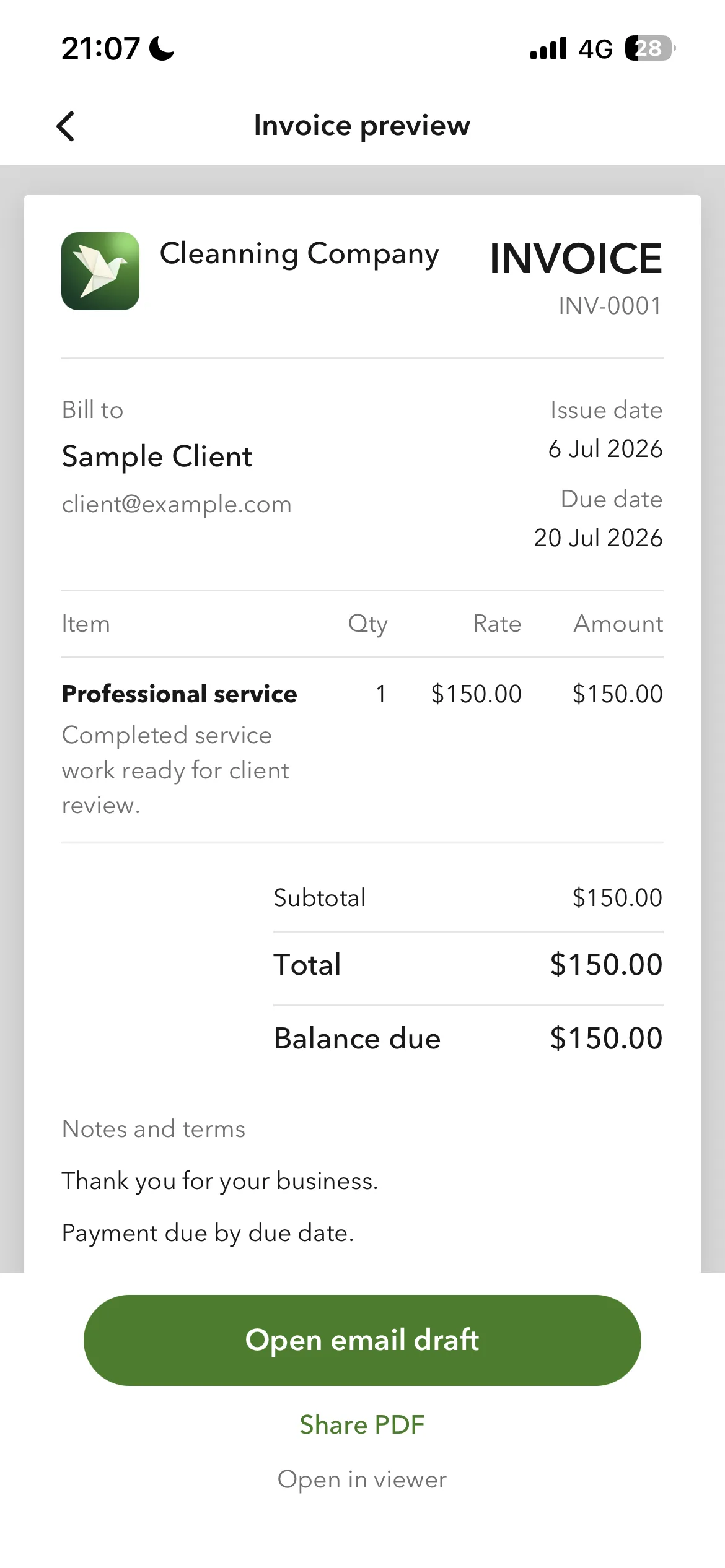
Same PDF invoice, faster on the second one. Send it before you have loaded the van.

  • Saved customers and reusable labor, parts, and call-out lines
  • One-tap PDF preview and share
  • Estimate to invoice in two taps once the customer approves
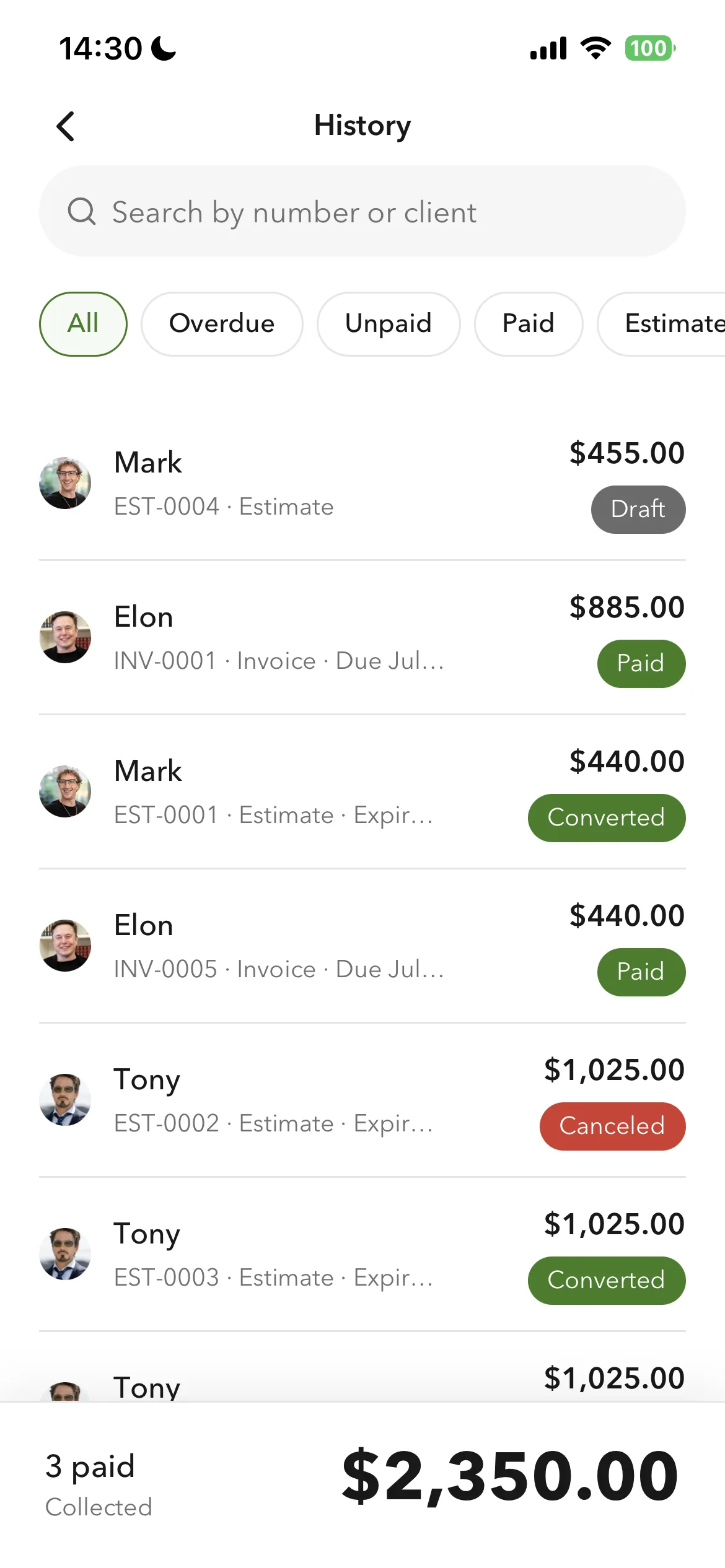
  • Manual paid, unpaid, and partial status tracking
Billgami PDF invoice preview screen on iPhone
Timing + payment

When should plumbers send an invoice, and how you get paid

When should you send a plumbing invoice?

SituationSend it
Standard service callBefore you leave the driveway, while the work is fresh.
Emergency or after-hours call-outSame day, with the call-out fee itemized so it is not a surprise.
Job that needed a permitAfter the inspection passes, unless you agreed to bill in stages.
Property manager or landlordOne invoice per unit, sent together, so they can allocate per property.
Any invoiceNever a week later. Late invoices get paid late.

How plumbers get paid after sending an invoice

Common payment methods

Bank transferZelleCheckCashThird-party processor
  • State a specific due date on every invoice, such as Net 14 or Due on completion.
  • Take a deposit on jobs where you have to buy the unit up front, and show it as a credit line on the final invoice.
  • Collect on site where you can. Plumbing has no equivalent of a mechanic's ability to hold the vehicle, so the job is finished and the leverage is gone once you drive away.
  • If an invoice goes past due, follow up politely and resend the same PDF so the customer has one clear document to pay.
Document practices

Invoice, estimate, quote, or work order: which plumbing document, and when?

Plumbers use four documents for the same job and it is easy to send the wrong one. A quick reference: an estimate or quote goes out before the work, a work order records what to do on site, and the invoice asks for payment after. Getting the sequence right is what makes the reconciled plumbing invoice sample above match the job.

Estimate or quote, before the work

Send a plumbing estimate template or a plumbing quote template before you start, so the customer approves the scope and the price in writing. An estimate signals a range that may move once the wall is open; a quote signals a firmer number you intend to hold. Either one becomes the reference the final invoice reconciles against.

  • Estimate: use for diagnostics and anything behind a wall, where the scope is genuinely unknown
  • Quote: use for predictable jobs you can price from memory, like a water heater swap
  • Whichever you send, put a number on it so the invoice can point back to it

Work order, during the job

A plumbing work order is the internal record of what to do on site: the address, the scope, the parts to bring, and space to note what you actually found. It is not a billing document, but it is where the approved-on-site changes get captured before they become invoice lines. Many plumbers still run these as a carbon-copy work order book; the same fields move cleanly into an app.

  • Records the job scope and the parts list for the tech on site
  • Captures changes approved in the driveway, with the date, before they hit the invoice
  • Not a demand for payment, so it does not replace the invoice

Invoice, after the work

The plumbing invoice is the only one of the four that asks for payment. It restates the approved estimate, adds any dated changes from the work order, shows the permit at cost, and credits any trip fee. The filled plumbing invoice sample above is exactly this document, reconciled line by line against the estimate that preceded it.

  • References the estimate or quote number so the two documents match
  • Carries the approved changes recorded on the work order as dated lines
  • Is the document that states the total due, the due date, and how to pay

FAQ

What do plumbers ask about invoice templates?

Clear answers on plumbing invoice templates, flat rate versus hourly billing, sales tax on labor, permits, emergency call-outs, and sending professional PDFs from a phone.

What should be on a plumbing invoice?

A plumbing invoice should include your business name, license number, and contact details, the customer's name and the service address, the date you did the work, a unique invoice number, labor and parts itemized on separate lines, any permit shown at cost, the subtotal, sales tax if it applies to your work, the total due, and payment terms. If you charged a trip or diagnostic fee and agreed to apply it to the repair, show it as a credit line so the balance due is what the customer actually owes. The fields are the same whether you searched for a plumbing invoice template or a plumber invoice template.

Should a plumber charge flat rate or time and materials?

Flat rate works for jobs you have priced many times, like a water heater swap or a toilet install, because the customer gets one number and you carry the risk if it runs long. Time and materials works for diagnostics and anything behind a wall, because the scope is genuinely unknown and the customer carries that risk instead. Most solo plumbers use both. What matters on the invoice is being consistent about which one you told the customer you were using, and showing approved additions as separate dated lines either way.

Do plumbers charge sales tax on labor?

It depends on your state, and this is where plumbing invoices most often go wrong. New York asks whether the job is a capital improvement to real property or a repair: installing a water heater is a capital improvement, while replacing that same heater's thermostat is taxable repair work. Texas asks instead whether the property is residential or nonresidential. California asks whether what you installed is a material or a fixture. Keep parts and labor on separate lines so the amounts stay separable, and confirm your own state rules before adding tax. This is not tax advice.

How do you bill an emergency or after-hours plumbing call?

Quote both parts on the phone before you drive out: the call-out fee and the after-hours labor rate. Published 2026 US data puts emergency call-out fees in the $200 to $300 range with an emergency hourly rate around $150, against a standard range of $75 to $150 per hour. On the invoice, put the call-out fee on its own line rather than folding it into labor. A customer who agreed to a fee on the phone will pay it, but only if they can see it as the same number they agreed to.

Should the permit fee go on the plumbing invoice?

Yes, and show it at cost as a pass-through so it does not read as markup. Permit costs vary widely by jurisdiction, from about $25 to $1,500 depending on the work and the location. If you charge for the time spent pulling the permit, make that a separate labeled line rather than inflating the permit amount. It is also worth noting on the invoice when the job still needs to pass inspection, so the customer knows the work is not formally closed yet.

What is the fastest way to send a plumbing invoice from my phone?

Save your customer and your common labor, parts, and call-out lines once, then reuse them next time. Billgami is built for that iPhone workflow: add the customer, add the lines, credit the trip fee, preview the PDF, and share it without rebuilding the document for every job. It works offline too, which matters in a basement or a crawlspace.

Is Billgami full accounting software?

No. Billgami is for invoices, estimates, quotes, receipts, PDF records, and manual status tracking. It is not tax, payroll, bookkeeping, or payment processing software.

Can I send PDFs from my iPhone?

Yes. Billgami is built around creating professional PDFs and sharing them through the iPhone share sheet or email workflows you already use.

Last updated: July 23, 2026

Phuc Doan

Phuc Doan

Founder of Billgami·Last updated July 23, 2026

Send your next plumbing invoice from your phone

Save the customer, reuse your labor and parts lines, credit the trip fee, share the PDF. Billgami helps solo plumbers send professional invoices from iPhone without accounting software.

Last updated: July 23, 2026 | Written by Phuc Doan

Billgami invoice history with paid, unpaid, and partial status on iPhone