
Billgami

Automotive Repair Invoice Template

Last updated: July 2026

This automotive repair invoice template helps a shop identify the customer and vehicle, separate labor from parts and fees, document the diagnostic finding and completed correction, record added work with the customer's authorization, state warranty terms, and reconcile the final amount against the approved estimate. Download the free PDF, Word, or Excel pack, use the filled brake repair example, or send the invoice from an iPhone with Billgami.

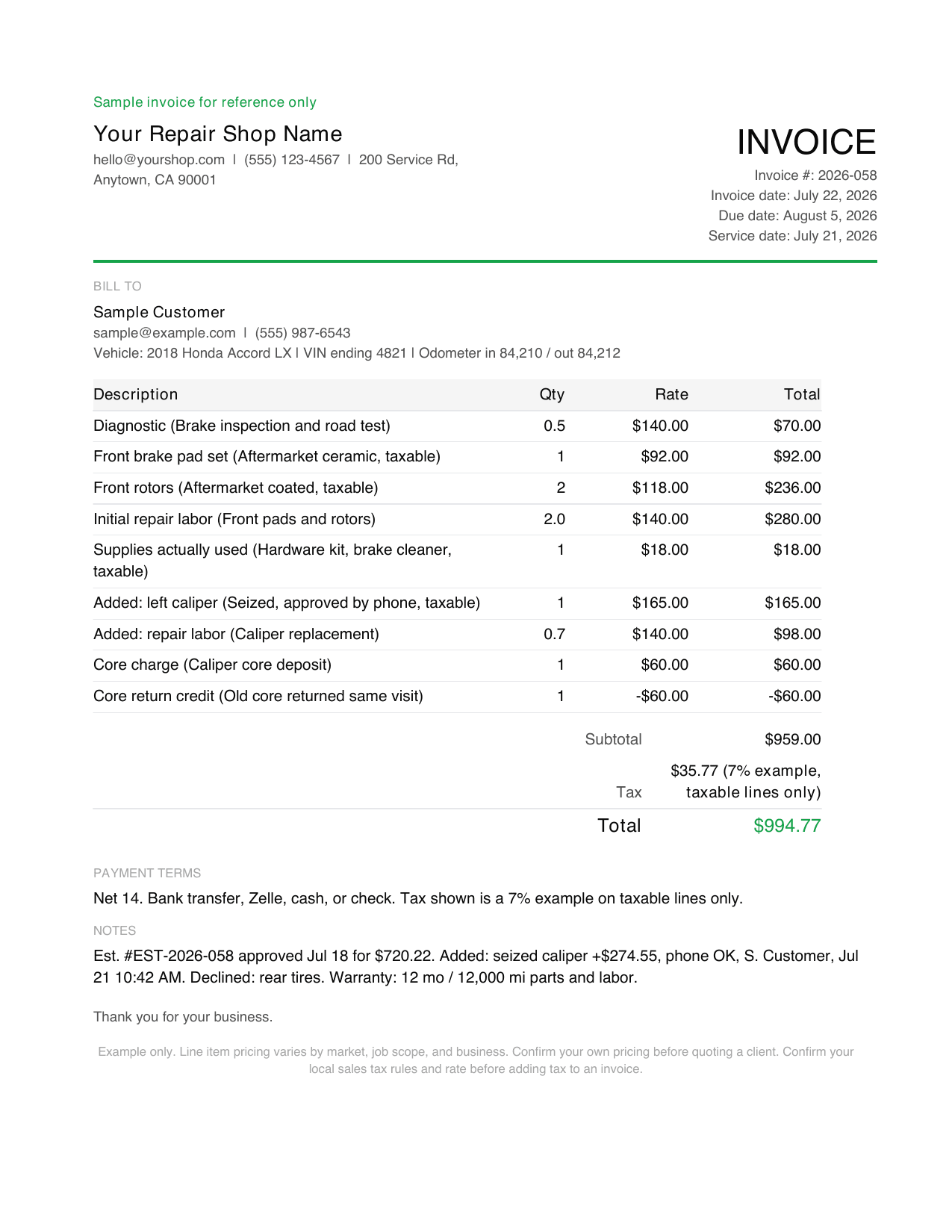
Preview of page 1 of the automotive repair invoice template with a filled brake repair sample, estimate reference, and approved change note

Download

What must be included

What must be included on an automotive repair invoice?

Core fields covered by this template, labeled on a real automotive repair invoice example: vehicle identification, itemized labor and parts with taxable flags, an authorized mid-repair addition, a core charge with its matching credit, and the total due filled in. Requirements vary by state.

Invoice

Sample auto repair invoice with an authorized mid-repair addition

Invoice #

2026-058

From

Your Repair Shop Name

hello@yourshop.com
(555) 123-4567
200 Service Rd, Anytown, CA 90001

Bill to

Sample Customer

sample@example.com
(555) 987-6543
Vehicle: 2018 Honda Accord LX, VIN ending 4821, odometer 84,210 in / 84,212 out

DescriptionQtyRateTaxTotal

Diagnostic

Brake inspection and road test

0.5$140.00N$70.00

Front brake pad set

Aftermarket ceramic

1$92.00Y$92.00

Front rotors

Aftermarket coated

2$118.00Y$236.00

Initial repair labor

Front pads and rotors

2.0$140.00N$280.00

Supplies actually used

Hardware kit, brake cleaner

1$18.00Y$18.00

Added: left caliper

Seized, approved by phone

1$165.00Y$165.00

Added: repair labor

Caliper replacement

0.7$140.00N$98.00

Core charge

Caliper core deposit

1$60.00N$60.00

Core return credit

Old core returned same visit

1-$60.00N-$60.00
Subtotal$959.00
Tax$35.77 (7% example rate on taxable parts and supplies only)
Total$994.77

Payment terms

Net 14. Bank transfer, Zelle, cash, or check. Tax shown is a 7% example on taxable lines only. Reference invoice number 2026-058 on payment and confirm your state tax rules.

Example only. The taxable subtotal here is $511.00 (pads, rotors, supplies, and the added caliper) taxed at an example 7% rate. Line item pricing varies by market, vehicle, and job scope. Taxability of parts, labor, and supplies varies by state. Confirm your own pricing and your state tax rules before sending an invoice.

What goes where

  • 1

    Shop info + registration

    Your shop name, phone, email, and address at the top. Add your state repair registration number if required in your state, and your EPA identification number if hazardous disposal fees apply.

  • 2

    Customer + vehicle

    Customer contact plus the vehicle block: year, make, model, VIN, plate, and odometer in and out. The odometer pair documents the road test.

  • 3

    Invoice number + estimate reference

    Unique invoice number, service and invoice dates, and the approved estimate reference so the customer can reconcile the final bill.

  • 4

    Itemized labor, parts, and fees

    Labor with hours and rate, parts with quantity, price, and aftermarket or OEM status, supplies itemized, and the core charge paired with its return credit.

  • 5

    Tax on taxable lines only

    The Tax column flags which lines are taxable. Here the taxable subtotal is $511.00 at an example 7% rate. Rules vary by state and by category.

  • 6

    Payment terms

    Due date, accepted payment methods, and the invoice number to reference. The shop is paid directly; Billgami never processes payments.

  • 7

    Concern, finding, correction

    The notes block records the customer concern, the technician finding, the completed correction, the approved change, declined work, and warranty terms.

Repair Transparency Ledger

What changed between the approved estimate and the final invoice?

The Billgami Repair Transparency Ledger tracks every work item from estimate to final invoice: what was approved, what was added mid-repair and who authorized it, what the customer declined, and how core charges and credits net out. It answers the question every repair customer asks: why is the final bill different from the estimate?

StatusWork itemWhyAuthorizationInvoice effect
approvedInitial diagnostic and brake repairMatches the original customer concernSigned estimate, July 18, 2026$720.22
addedSeized caliper replacementFound after disassemblyPhone approval, S. Customer, July 21 at 10:42 AM+$274.55
addedCaliper core chargeDeposit pending old core returnIncluded with caliper approval+$60.00
creditReturned caliper coreOld core returned same visitRecorded on invoice line-$60.00
declinedRear tiresSeparate safety recommendationCustomer declined$0
warrantyBrake repair coverageDefines the future remedyWritten terms on invoice$0

Final invoice = approved estimate + authorized additions + charges − credits. Here: $720.22 + $274.55 + $60.00 − $60.00 = $994.77.

The Repair Transparency Ledger is an original documentation framework, not a legal standard. Authorization requirements for added work vary by state; California and Florida both require customer authorization before work beyond the approved estimate.

How to

How do you send an automotive repair invoice?

  1. 1

    Download the PDF, Word, or Excel file and open it in your editor.

  2. 2

    Fill in your shop info, the customer, and the vehicle: year, make, model, VIN, plate, and odometer.

  3. 3

    Itemize diagnostic, labor, parts, and fees as separate lines, and mark which lines are taxable in your state.

  4. 4

    Record the estimate reference and the authorization for any work added after disassembly.

  5. 5

    Save as PDF and share by email or your phone share sheet.

Line-item reference

How should parts, labor, and repair fees appear on the invoice?

Common automotive repair line items, grouped by category, with the billing basis a customer expects to see. Categories only: your rates depend on your market. Supplies guidance follows California BAR itemization rules; fee notes follow the Florida FDACS sample form.

Line itemBilling basisNotes
Diagnostic
Diagnostic laborFlat fee or hourlyMany shops credit the diagnostic fee toward the repair if the customer approves the work
Scan tool feeFlat feeCharge it as its own line when advanced equipment time is real cost
Road testIncluded or hourlyDocument odometer in and out so the test is visible on the record
Labor
Flat-rate laborBook hours x shop rateIf you use a flat-rate labor time guide such as Mitchell1 or ALLDATA, enter the book hours instead of clock hours
Hourly laborClock hours x shop rateCommon for diagnosis-heavy or unknown-scope work
Sublet laborPass-through plus markupMachine work, glass, alignment sent out; disclose it as sublet
Parts
OEM partsPer part with quantityOriginal equipment; note the part status on the line
Aftermarket partsPer part with quantityThe most common choice; both California and Florida sample paperwork carry a part condition designation
Rebuilt or remanufactured partsPer part with quantityOften paired with a core charge; disclose the status
Used partsPer part with quantityDisclose clearly; some states require customer consent for used parts
Fluids
Motor oilPer quart or flatShow grade and quantity
Coolant, brake, or transmission fluidPer unit or flatSame treatment as oil: show what went in the vehicle
Supplies
Shop supplies actually usedItemized per jobCalifornia BAR guidance: supplies actually used must be itemized; a generic shop supplies percentage line is prohibited there
Specialty consumablesItemized per jobSolvents, sealants, gaskets, hardware kits sold as part of the repair
Fees
Disposal feeFlat per itemHazardous disposal fees can trigger extra requirements in some states, including an EPA identification number on California paperwork
Environmental or state-set feesFlat per itemFlorida law sets specific fees on repair paperwork: $1.00 per new tire (FS 403.718) and $1.50 per new battery (FS 403.7185)
Core charges
Core chargeFlat deposit per partA refundable deposit on rebuildable parts such as calipers, alternators, and batteries
Core return creditNegative lineShow the credit next to the charge; the pair nets to zero when the old core is returned
Taxes
Sales taxRate x taxable subtotalTaxability of parts, labor, and supplies varies by state and by category; mark taxable lines and confirm your rules
Warranty and goodwill
Warranty repair$0 to customerShow the work at zero so the record proves the remedy was delivered
Goodwill adjustmentNegative lineA discretionary discount; label it so the record stays honest

Billing scenarios for auto repair work

Diagnostic only, customer declines the repair

Bill the diagnostic line on its own invoice. Note the finding and the declined recommendation so the record stands if the customer returns.

Estimate approved, repair completed as quoted

Invoice matches the estimate: reference the estimate number, itemize the same lines, and mark taxable lines before totaling.

Added work found after disassembly

Stop, get authorization, record who approved it and when, then bill the addition as its own clearly labeled lines. The ledger above shows the full pattern.

Customer supplies their own parts

Bill labor only, note customer-supplied parts on the invoice, and state in writing that parts warranty is excluded when the customer sourced the parts.

Sublet work (machine shop, glass, alignment)

Pass the sublet through as its own line, with or without markup, and label it sublet so the customer knows who performed it.

Warranty comeback on a previous repair

Rework covered by your warranty bills at $0 to the customer. Show the work at zero so the record proves the remedy was delivered.

How this template was built

We reviewed the ten pages ranking for automotive repair invoice template on July 23, 2026. Of the seven we could fully load, none showed an author, a cited government source, a labor or fee reference table, or a filled line-item sample; the remaining three were access-blocked, and their titles and search snippets showed none of these signals either. This page was built against primary sources instead: California BAR's Write It Right guide, Florida's FDACS sample estimate and invoice form, and the FTC's Auto Repair Basics, each verified on July 23, 2026. The filled sample and the Repair Transparency Ledger reconcile to the penny, and the same numbers drive the PDF, Word, and Excel downloads. Requirements vary by state; the sources below are references, not legal advice.

  • California BAR, Write It Right: https://www.bar.ca.gov/wir
  • Florida FDACS Sample Repair Shop Estimate and Invoice: https://ccmedia.fdacs.gov/content/download/116437/file/Sample-Repair-Shop-Estimate-and-Invoice.pdf
  • FTC Auto Repair Basics: https://consumer.ftc.gov/articles/auto-repair-basics
Official guidance

Official documentation references

Auto repair invoice requirements vary by state. These are official documentation references from two states plus national consumer-protection guidance, each fetched and verified on July 23, 2026. The sample and ledger math on this page was independently derived and reconciled, and the same numbers drive the PDF, Word, and Excel downloads. Confirm current rules with your state regulator before printing invoices in production. Not legal advice.

California

Bureau of Automotive Repair: Write It Right

California BAR guidance requires written estimates, customer authorization for added work, and itemized invoices. Supplies actually used must be itemized; generic shop-supplies charges are prohibited. When certain hazardous-disposal fees are charged, the paperwork may also need the repair dealer's EPA identification number.

Read Write It Right at bar.ca.gov

Not legal advice. Confirm current rules with California BAR before printing invoices in production. Source verified 2026-07-23.

Florida

FDACS sample repair estimate and invoice

Florida's consumer services department publishes a sample combined estimate and invoice form. It shows the customer's right to a written estimate when the final bill will exceed $150, the shop's MV registration number, a save-old-parts checkbox, part condition codes, and flat-rate versus hourly labor election.

Download the FDACS sample form (PDF)

Not legal advice. Confirm current rules with FDACS before printing invoices in production. Source verified 2026-07-23.

United States

FTC: Auto Repair Basics

The FTC's national consumer guidance covers choosing a repair shop, getting estimates and authorizing work, understanding repair charges on the invoice, warranty coverage, and where to complain when something goes wrong. It is the baseline your customers read.

Read Auto Repair Basics at consumer.ftc.gov

Not legal advice. State rules vary. Consult your state regulator. Source verified 2026-07-23.

Common mistakes

What are the most common auto repair invoice mistakes?

No authorization record for work added mid-repair

Record who approved the addition, through which channel, and when. California and Florida both require authorization before exceeding the approved estimate.

A generic shop supplies percentage line

Itemize the supplies actually used. California BAR prohibits generic shop-supplies charges, and itemized lines read as honest everywhere.

Missing vehicle identification

Include year, make, model, VIN, plate, and odometer in and out. Complete vehicle identification is standard practice: both California BAR guidance and Florida's FDACS sample form carry vehicle identification fields, and a complete record makes warranty claims far easier to support.

Core charge with no matching credit line

Show the core charge and its return credit as a visible pair. A charge that silently disappears into the total invites a dispute.

Taxing every line the same way

Parts, labor, and supplies are taxed differently by state. Mark taxable lines, compute tax on the taxable subtotal only, and confirm your state rules.

No record of declined recommendations

List declined work at $0. It protects the shop if the declined item fails later and shows the customer you flagged it.

Warranty terms left off the invoice

State parts and labor warranty in months and miles on the document itself, not verbally. The invoice is the record the customer keeps.

Sending the invoice days after pickup

Bill at pickup, before the vehicle leaves. Fresh work is easiest to pay for, and the signed record closes the job cleanly.

Template or app

Should you use a free auto repair invoice template or an invoice app?

NeedFree templateBillgami app
Editable
Yes
Yes
Reuse a saved customer on the next invoice
No, retype every time
Saved client records
Reuse common repair line items
Copy and paste manually
Reusable service library
Vehicle details on the invoice
Type into the template fields
Manual entry in description or notes
Line totals and tax math
Manual (Excel file has formulas)
Line totals computed, tax entered manually
Estimate to invoice conversion
Rebuild the document
In-app conversion
Works at the customer's location
Editable anywhere, but no saved records
Built for iPhone
Paid, unpaid, partial tracking
On paper
In-app, manual status
Cost
Free
Free tier plus $249.99 lifetime option

Need full shop management with parts inventory, tech scheduling, and bays? Tekmetric, Shopmonkey, or Mitchell1 Manager fit better. For a solo mechanic or mobile mechanic who needs professional paperwork without a monthly platform, both are overkill.

From template to phone

What this workflow looks like in Billgami on iPhone

  • Save the customer once and reuse the record on every future invoice
  • Build a library of common repair lines: diagnostic, labor, parts, fees
  • Convert an approved estimate into an invoice in the app
  • Track paid, unpaid, and partial status manually as customers pay you directly
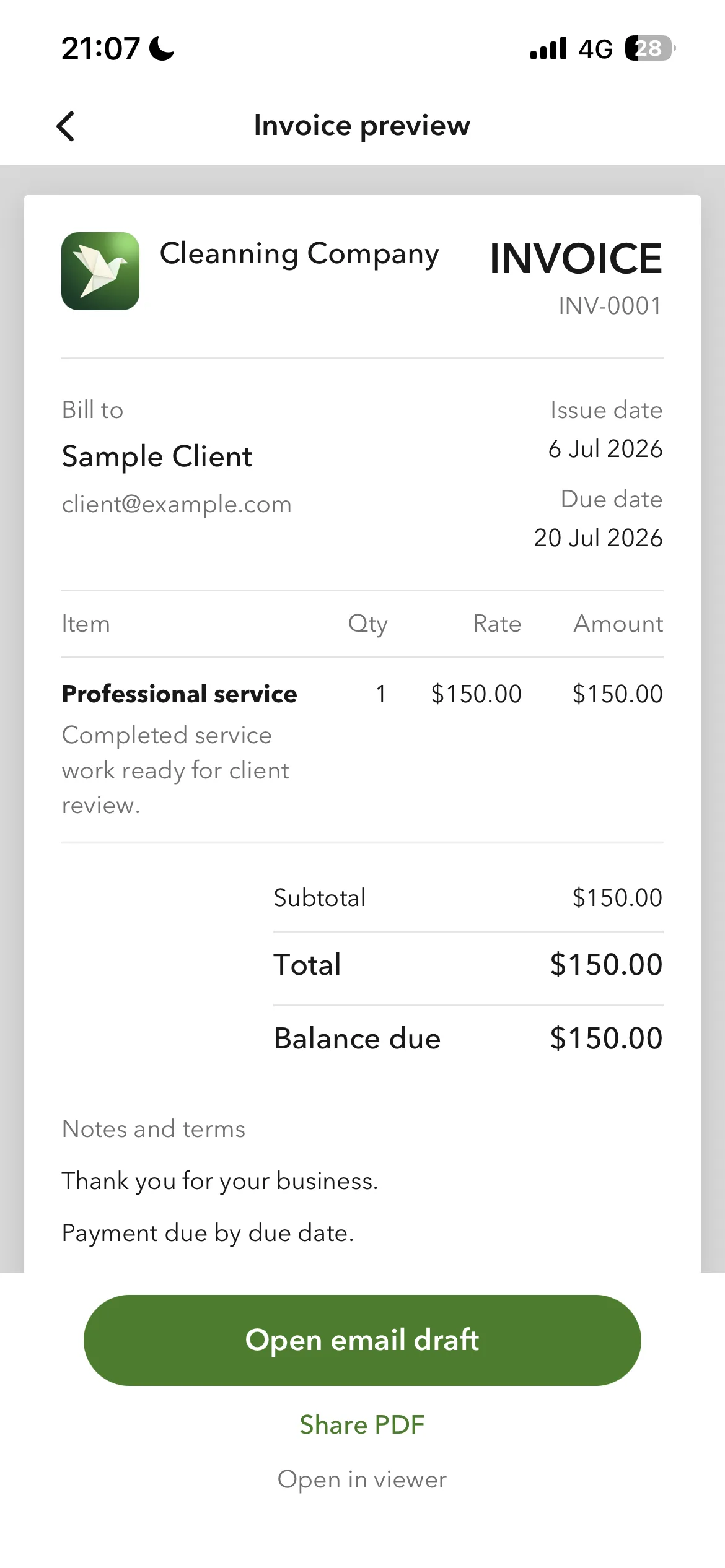
Billgami PDF invoice preview screen on iPhone
Timing + payment

When to send the invoice, and how you get paid

When should you send an auto repair invoice?

SituationSend it
Diagnostic onlyAt pickup, even when the customer declines the repair.
Repair completed as estimatedAt pickup, before the vehicle leaves the shop.
Added work was authorized mid-repairAt pickup, with the addition reconciled against the estimate.
Mobile or roadside jobOn-site, from your phone, before you leave.
Any invoiceNever days later. Fresh work is easiest to pay for.

How mechanics get paid after sending an invoice

Common payment methods

Bank transferZelleCheckCashCard processor
  • State a specific due date on every invoice, such as Due on receipt or Net 14.
  • List your accepted payment methods in the payment terms block so the customer knows how to pay.
  • If the invoice is unpaid past the due date, follow up politely and resend the same invoice PDF.
Document practices

Authorization, warranty, and record retention

Three document practices separate a professional repair invoice from a receipt scribbled on a work order.

Authorization capture

Every dollar on the final invoice should trace to an authorization: the signed estimate for the original scope, and a recorded approval for anything added after disassembly.

  • Record the channel: signature, phone, or text
  • Record the person and the timestamp
  • Reference the estimate number on the invoice

Warranty terms in writing

State the parts and labor warranty in months and miles on the invoice itself. A verbal warranty is a dispute waiting to happen; a written one defines the remedy.

  • Separate parts warranty from labor warranty
  • Exclude customer-supplied parts in writing
  • Show warranty rework at $0 on later invoices

Record retention

Keep every invoice, estimate, and authorization record. The paper trail supports warranty claims, tax filings, and any dispute about what was approved.

  • Keep the estimate and invoice as a pair
  • Export or back up records regularly
  • Match retention to your state's requirements

FAQ

What do mechanics ask about invoice templates?

Clear answers on automotive repair invoice templates, estimate changes, labor billing, and how solo mechanics send professional PDFs from a phone.

What should be on an automotive repair invoice?

An automotive repair invoice should include your shop's name and contact information, your state repair registration number if required in your state, the customer's name, the vehicle's year, make, model, VIN, plate, and odometer reading, a unique invoice number with the estimate reference, the customer concern and technician finding, itemized labor with hours and rate, itemized parts with condition status, supplies actually used, fees such as disposal and core charges, sales tax on taxable lines, warranty terms, and payment terms. The same structure works as a mechanic invoice template for fixed shops and mobile mechanics alike.

Can a mechanic charge more than the estimate?

Rules vary by state, and the two states cited on this page both regulate it: California requires customer authorization before work beyond the approved estimate, and Florida's paperwork is built around a written estimate election when the bill will exceed $150. Check your own state's rules. The safe pattern everywhere is the one in the ledger above: stop when new work is found, record who approved it and when, and bill the addition as its own labeled lines.

How do mechanics bill labor, flat rate or hourly?

Both are standard. Flat-rate billing charges book hours from a labor time guide such as Mitchell1 or ALLDATA multiplied by the shop rate, regardless of clock time. Hourly billing charges actual time, which fits diagnosis-heavy or unknown-scope work. Whichever you use, show the hours and the rate on each labor line so the customer can verify the math.

Are shop supplies taxable, and how should they appear?

Itemize the supplies actually used rather than adding a generic percentage line. California BAR prohibits generic shop-supplies charges outright. Taxability varies by state: some states tax supplies like parts, others treat them differently. Mark the supply line's taxable flag according to your state's rules and confirm with your state revenue department.

What is the difference between an auto repair estimate and an invoice?

The estimate is the approval document: it states the expected scope and price before work starts, and the customer authorizes it. The invoice is the payment document: it states what was actually done and what is owed. On a clean repair the two match. When work was added mid-repair, the invoice should reconcile against the estimate, which is exactly what the change ledger on this page documents.

Does this template work for auto detailing?

Detailing is a different trade: washing, polishing, and interior work rather than mechanical repair. This template's vehicle block and itemized lines still function, but the repair-specific fields such as the diagnostic finding, core charges, and parts condition codes will not apply. A simple service invoice with your detailing packages as line items fits better.

Is Billgami full accounting software?

No. Billgami is for invoices, estimates, quotes, receipts, PDF records, and manual status tracking. It is not tax, payroll, bookkeeping, or payment processing software.

Can I send PDFs from my iPhone?

Yes. Billgami is built around creating professional PDFs and sharing them through the iPhone share sheet or email workflows you already use.

Last updated: July 23, 2026

Phuc Doan

Phuc Doan

Founder of Billgami·Last updated July 23, 2026

MethodologyBuilt against California BAR, Florida FDACS, and FTC primary sources, each verified July 23, 2026. Sample math independently derived and reconciled.

Not legal, tax, or accounting advice. Repair invoice requirements and taxability vary by state. Confirm current rules with your state regulator before using any template in production.

Send your next auto repair invoice from your phone

Save the customer, reuse the repair lines, share the PDF at pickup. Billgami helps solo mechanics and mobile mechanics send professional invoices from iPhone without shop-management software.

Last updated: July 23, 2026 | Written by Phuc Doan

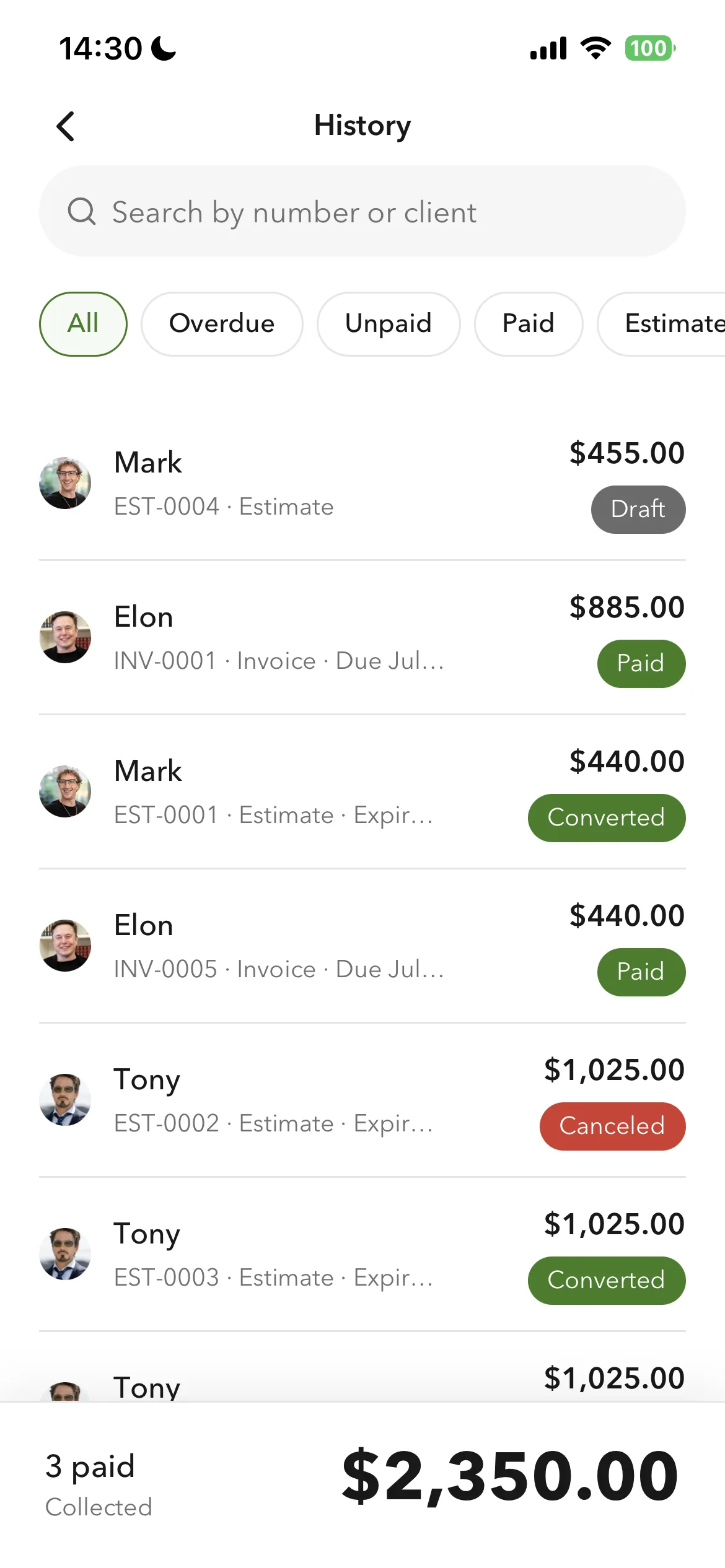
Billgami invoice history with paid, unpaid, and partial status on iPhone