Billgami

Catering Invoice Template

Last updated: July 2026

A catering invoice needs your company details, the client and venue, the event date, itemized per-head and flat lines billed at the guaranteed guest count, a clearly labeled service charge, rentals and staffing, tax on the taxable lines, the deposit credited, and the balance due. Catering is billed against the guaranteed count the client locked before the event, not against who actually showed up, which is the rule most templates never explain. Download the free template below, see a filled event sample, or send one from your phone in Billgami.

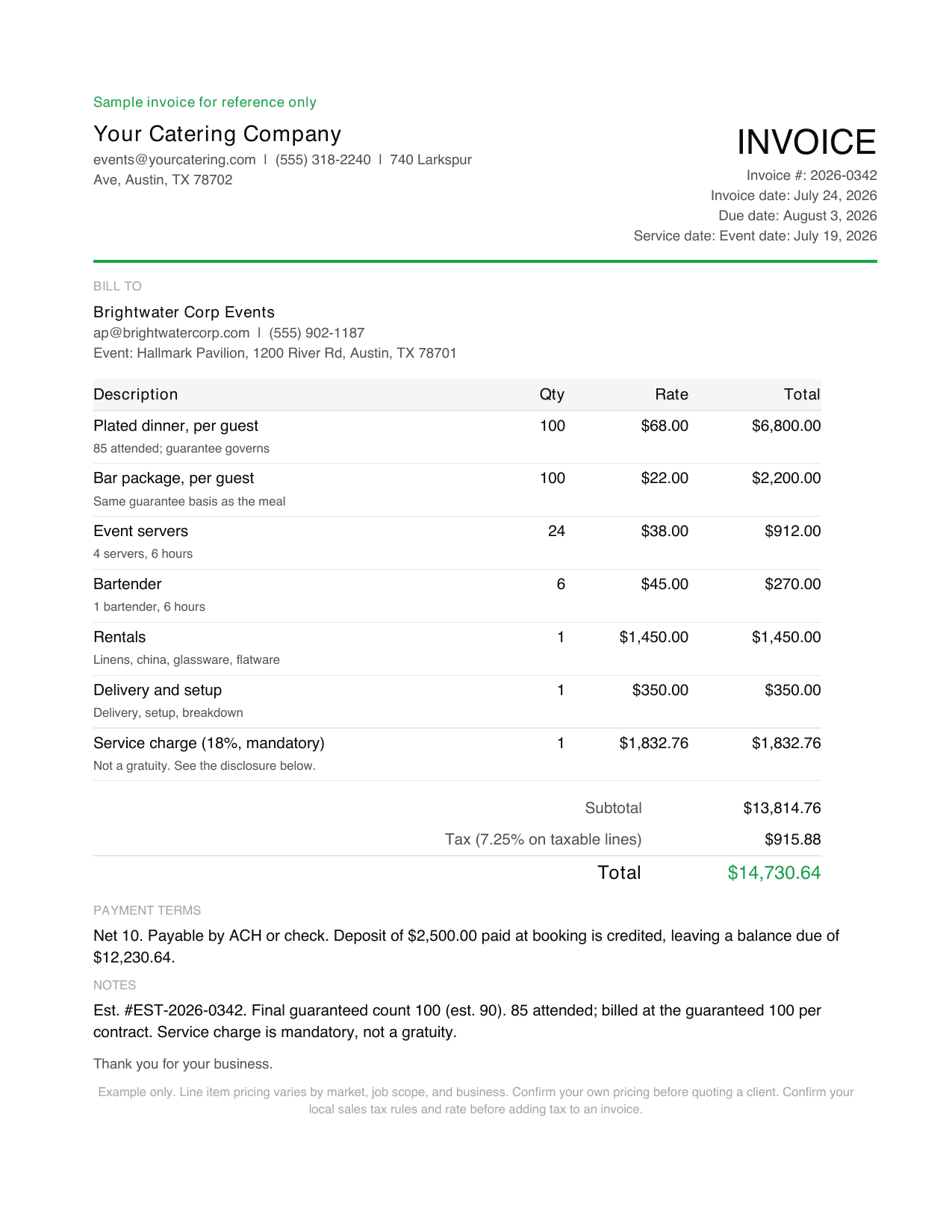
Preview of the catering invoice template with a filled plated-dinner event sample billed at the guaranteed guest count

Download

What must be included

What must be included on a catering invoice?

Every required field labeled on a real catering invoice example, with per-head dining billed at the guaranteed count, staffing, rentals, a mandatory service charge, tax on the taxable lines, and the deposit credited. Use it as a catering invoice sample or catering bill format, whichever you searched for, since the structure is the same.

Invoice

Sample catering invoice (with real numbers)

Invoice #

2026-0342

From

Your Catering Company

740 Larkspur Ave
Austin, TX 78702
events@yourcatering.com

Bill to

Brightwater Corp Events

Attn: Accounts Payable
Event: Hallmark Pavilion
1200 River Rd, Austin, TX 78701

DescriptionQtyRateTaxTotal

Plated dinner, per guest

Billed at guaranteed count of 100 (85 attended)

100$68.00Y$6,800.00

Bar package, per guest

Beer, wine, and two signature cocktails, billed at 100

100$22.00Y$2,200.00

Event servers

4 servers, 6 hours

24$38.00N$912.00

Bartender

1 bartender, 6 hours

6$45.00N$270.00

Rentals

Linens, china, glassware, and flatware

1$1,450.00Y$1,450.00

Delivery and setup

On-site delivery, setup, and breakdown

1$350.00Y$350.00

Service charge (18%, mandatory)

On food, beverage, and labor. Not a gratuity. Taxable.

1$1,832.76Y$1,832.76
Subtotal$13,814.76
Tax$915.88 (7.25% on the taxable lines only, if it applies)
Total$14,730.64

Payment terms

Net 10. Payable by ACH or check. Deposit of $2,500.00 paid at booking is credited, leaving a balance due of $12,230.64. Billgami does not process or hold payments, so the client pays you directly by the method you name here.

Example only. Rates vary by market, menu, and service style. Confirm your own pricing before quoting a client. The 7.25% rate and the taxable flags shown are illustrative, not the rules of any single state; states differ on whether labor, rentals, and service charges are taxable. Prepared food is taxable in most states. Confirm your local rate and which lines are taxable before adding tax.

What goes where

  • 1

    From block

    Your catering company name, address, and contact. Add your sales-tax permit number if your state requires it.

  • 2

    Bill to block

    The client or company, the on-site contact, and the venue and event address, not just the billing address.

  • 3

    Invoice number

    A unique number, the invoice date, and the event date so the invoice matches the event.

  • 4

    Itemized line items

    Per-head meal and bar at the guaranteed count, then staffing, rentals, and delivery each on their own line.

  • 5

    Sales tax line

    Prepared food is taxable in most states. Show the taxable base and rate separately and confirm which lines apply in your state.

  • 6

    Total due

    Subtotal plus tax, then the deposit credited and the balance due. The number the client pays.

  • 7

    Payment terms

    Due date, accepted methods, and the deposit credit. Billgami does not collect payments in-app, so name the method the client should use.

Guest count reconciliation

How do you invoice when the guest count changes?

Catering bills against the final guaranteed count the client locks before the event, not against who actually attends. This event estimated 90, guaranteed 100, and 85 showed up. The invoice bills 100. This is the single most disputed line in catering, so the record shows every movement. The event was quoted at $12,752.76 for the estimated 90 guests and billed at $13,814.76 once the per-head lines moved to the guaranteed 100.

StatusWork itemWhyAuthorizationInvoice effect
approvedEstimated count at bookingInitial quote basisEstimate EST-2026-034290 guests, quoted per head
addedFinal guaranteed countClient raised and locked the count before the deadlineEmail confirmation 2026-07-14, five days outPer-head lines rebilled at 100
declinedReduce billing to actual attendance (85)Guarantee governs; the client committed to 100Contract guarantee clauseNo reduction; billed count stays 100

Billed count = the greater of guaranteed (100) and attended (85) = 100. 100 guests x $68.00 = $6,800.00 on the plated-dinner line.

Billgami does not track guest counts or attendance. Guest-count billing is a manual entry on the invoice. Example only; your guarantee terms and deadline are set by your contract.

Service charge vs gratuity

Is a catering service charge the same as a tip, and is it taxable?

A mandatory service charge and a voluntary gratuity are not the same thing, and they are taxed differently. Under IRS Rev. Rul. 2012-18, a mandatory service charge is business revenue and wages, not a tip, so it is generally taxable. A voluntary tip the client chooses is not. Confusing the two is the most common catering compliance mistake.

Line typeWho it goes toTaxable?How it appears on the invoice
Mandatory service chargeThe business (may be paid out as wages)Yes in most statesIts own line, labeled mandatory, before tax
Voluntary gratuity or tipStaffNo, when it meets the IRS tip testA separate optional line the client chooses to add
Administrative or setup feeThe businessUsually, like a service chargeIts own line, described plainly

Service charge = base $10182.00 x 18% = $1832.76, shown as its own invoice line.

Billgami calculates nothing here automatically. The service charge is a manual line you add. This section shows how to document and classify it on the invoice.

General information, not legal or tax advice. Service-charge and tip tax treatment varies by state. Confirm your rules before invoicing.

  • IRS Rev. Rul. 2012-18 (mandatory service charges are wages, not tips): https://www.irs.gov/pub/irs-drop/rr-12-18.pdf
  • IRS four-part tip test: free from compulsion, customer sets amount, not negotiated, customer determines recipient.
How to

How do you make a catering invoice?

  1. 1

    Download the PDF, Word, or Excel file and open it in your editor.

  2. 2

    Fill in your company details, the client, the on-site contact, and the venue and event date.

  3. 3

    Itemize per-head lines at the final guaranteed guest count, then add staffing hours, rentals, delivery, and the service charge on their own lines.

  4. 4

    Mark which lines are taxable in your state, apply tax, then credit the deposit and show the balance due.

  5. 5

    Save as PDF and send it to the client within 24 to 48 hours of the event.

2026 pricing data

How much does catering cost per person in 2026?

These are typical per-head prices charged by caterers in the US in 2026, drawn from public pricing data, grouped by service style. Ranges vary by region, menu, and whether staffing is included. Use them as a benchmark, not a fixed rate.

ServiceUnitBilling basisRangeSource
By service style
Drop-off cateringPer guestStaff not included$15 to $30Thumbtack 2026Accessed 2026-07-24
Buffet servicePer guestStaff sometimes included$25 to $55Thumbtack 2026Accessed 2026-07-24
Plated servicePer guestStaff included$45 to $95, higher for full serviceThumbtack 2026Accessed 2026-07-24
Wedding cateringPer guestStaff included$62 to $123 (average about $80)The Knot 2026Accessed 2026-07-24

Billing scenarios for caterers

Deposit at booking

Invoice the deposit on its own, then credit it as a negative line on the final invoice.

Guest count changes before the event

Rebill per-head lines at the final guaranteed count. Bill the guarantee even if fewer attend.

Guests added within the cutoff window

Bill overage above the guarantee at your stated day-of rate on a separate line.

Event runs long

Bill additional staffing and bar hours at the overtime rate as their own lines.

Rentals and specialty items

List linens, china, and equipment separately, marked taxable where your state requires it.

Service charge and gratuity

Keep the mandatory service charge and any voluntary tip on separate lines with different tax treatment.

How we sourced the 2026 per-head figures

The per-head price bands above are drawn from public 2026 US catering pricing guides, grouped by service style because service style is the single biggest cost driver. Drop-off, buffet, and plated figures come from Thumbtack's catering cost data, and the wedding band comes from The Knot's average wedding catering cost, with WeddingWire as supporting cost context. Ranges reflect what caterers charge, vary by region and menu, and depend heavily on whether staffing is included. Use them as a benchmark and adjust for your market. They are not a rate to copy.

  • Thumbtack: https://www.thumbtack.com/p/catering-costs
  • The Knot: https://www.theknot.com/content/average-cost-wedding-catering
  • WeddingWire: https://www.weddingwire.com/cost/wedding-catering
Common mistakes

What are the most common catering invoice mistakes?

Billing actual attendance instead of the guarantee

Bill the final guaranteed count the client locked. That is what they committed to pay.

Labeling a mandatory service charge as gratuity

A mandatory charge is a service charge, not a tip, and is generally taxable under IRS Rev. Rul. 2012-18. Label it plainly.

Lumping the whole event into one catering line

Itemize per-head food, bar, staffing, rentals, delivery, and service charge so the client can see each part.

Forgetting the deposit credit

Show the deposit as a negative line and state the balance due so the client is not double-billed.

Charging tax on the wrong lines

Food is taxable in most states, but labor, rentals, and service charges vary. Confirm which lines are taxable in your state.

No final guaranteed count on the invoice

State the guaranteed count the invoice is built against so the per-head math is transparent.

Missing the venue and event date

Include the venue address and event date, not just the client billing address.

Sending the invoice weeks after the event

Send within 24 to 48 hours while the event details are fresh and easy to verify.

Template or app

Should you use a free catering invoice template or an invoice app?

NeedFree templateBillgami app
Editable
Yes
Yes
Reusable client and menu records
No, retype every time
Saved records
Reusable per-head and service lines
Copy and paste manually
Saved as reusable items
Automatic line totals
Manual, or a spreadsheet formula
Calculated per line
PDF export
Manual export
Export from iPhone
Estimate to invoice conversion
Not supported
Supported in app
Deposit and balance tracking
On paper
Manual paid, unpaid, partial in app
Tracks guest counts or staffing
No
No, use your event tools for that
Cost
Free
Free tier plus $249.99 lifetime option

Need catering management with guest lists, staffing, and event timelines? Use dedicated catering software for that. Need full accounting? Use QuickBooks. For a caterer who needs a professional per-event invoice, both are more than the job requires.

What Billgami looks like on iPhone

Same per-event invoice, faster on the next one. Save your menu lines and reuse them.

  • Saved clients and reusable per-head, bar, and service lines
  • PDF preview and share from your phone
  • Estimate to invoice conversion after the client approves
  • Manual paid, unpaid, and partial status tracking
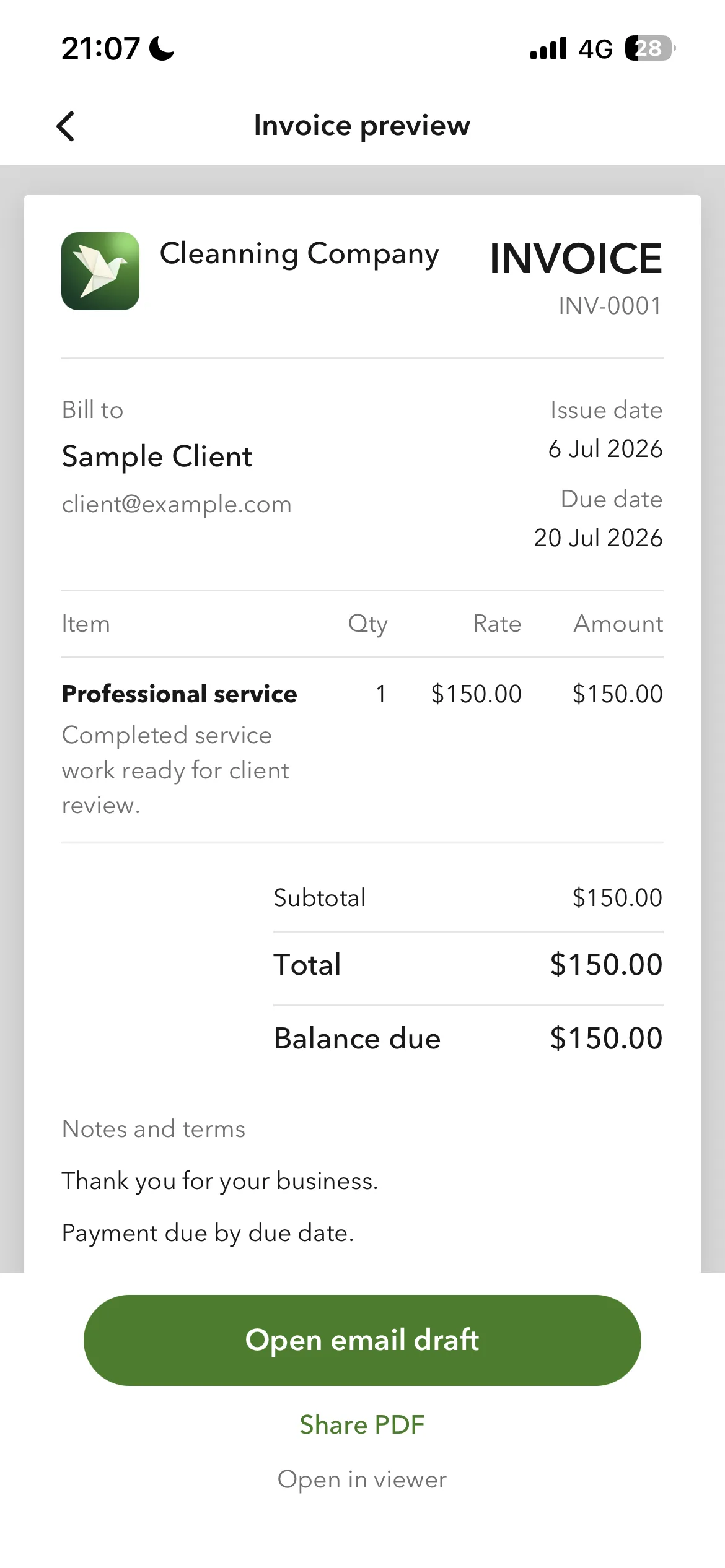
Billgami PDF invoice preview screen on iPhone
Timing + payment

When to send the invoice, and how you get paid

When should a caterer send the invoice?

SituationSend it
Deposit invoiceAt booking, to secure the date and cover upfront buying.
Final invoiceWithin 24 to 48 hours of the event while details are fresh.
Corporate clientEarly enough to clear their accounts payable cycle.
Guaranteed count changeReflect the locked count on the final invoice, not a separate bill.
Any invoiceNever wait weeks. Fresh events are easiest to reconcile.

How caterers get paid after sending an invoice

Billgami does not process or hold payments. Clients pay you directly using the method you name on the invoice.

Common payment methods

ACH or bank transferCheckCardCash
  • State the deposit credit and balance due clearly so there is no double-payment confusion.
  • Put accepted payment methods and the due date on every invoice.
  • For corporate clients, send to accounts payable, not just your event contact.
Document practices

How do you set catering deposit and payment terms that hold up?

Catering carries real upfront cost, food, staff, and rentals, so the payment structure protects both sides. These are documentation practices, not automation.

Take a deposit and credit it clearly

A deposit secures the date and covers upfront buying. Show it as a credit on the final invoice so the balance due is obvious.

  • State the deposit amount and date on the final invoice
  • Credit it as a negative line, not a mental subtraction
  • Show the balance due as its own figure

Lock the guaranteed count with a deadline

Put the final-count deadline in the contract and note the locked count on the invoice, so the per-head total is never a surprise.

  • Get the final count in writing before the deadline
  • Note the locked count and date on the invoice
  • State your overage rate for guests added after the deadline

Separate the service charge from the tip

Keep the mandatory service charge and any voluntary gratuity on separate lines, because they are taxed and distributed differently.

  • Label the service charge mandatory if it is
  • Leave gratuity optional and client-chosen
  • Confirm your state tax treatment for each

FAQ

What do caterers ask about invoice templates?

Clear answers on catering invoice templates, guaranteed guest counts, service charge versus gratuity, deposits, and per-head pricing.

What should be included on a catering invoice?

A catering invoice template, sometimes searched as a food catering invoice, should include your company name and contact, the client and the venue, the event date, a unique invoice number, the final guaranteed guest count, itemized per-head and flat lines, staffing and rentals, a clearly labeled service charge, tax on the taxable lines, the deposit credited, and the balance due. Building the per-head lines at the guaranteed count is what keeps the total transparent.

How do you invoice a catering job when the guest count changes?

Catering bills against the final guaranteed count the client locks before the event, usually 3 to 7 days out, not against who actually attends. If more guests come than the guarantee, add the overage at your stated rate. If fewer come, the client still pays the guarantee they committed to. State the guaranteed count on the invoice so the per-head math is clear.

Is a catering service charge the same as a tip, and is it taxable?

No. A mandatory service charge is business revenue and, under IRS Rev. Rul. 2012-18, is treated as wages rather than a tip, so it is generally taxable. A voluntary gratuity the client chooses is a tip and is not taxed the same way. Keep them on separate lines and confirm your state's tax treatment, because it varies.

How do caterers invoice a deposit and the final balance?

Invoice the deposit at booking to secure the date, then on the final invoice list the full event total and credit the deposit as a separate negative line so the balance due is obvious. Deposits of a set percentage are common; put the figure in your contract rather than introducing it at invoice time.

How much should catering cost per person in 2026?

Per-head pricing depends mostly on service style. In 2026, drop-off catering typically runs about $15 to $30 per person, buffet about $25 to $55, plated service about $45 to $95 and higher for full service, and wedding catering about $62 to $123 with an average near $80. Whether staffing is included is the biggest swing, so clarify it on the invoice.

How do you bill per-person catering with staffing and rentals?

Put the per-head food and bar on their own lines at the guaranteed count, then add staffing hours, rentals, and delivery as separate flat or hourly lines. Mark which lines are taxable in your state. Keeping each component on its own line lets the client see exactly what they are paying for and reduces disputes.

When should a caterer send the final invoice?

Send the final invoice within 24 to 48 hours of the event, while the details are fresh and easy to verify. Adjust for the final guaranteed count and any day-of additions, credit the deposit, and state the balance due. Sending promptly also helps you get paid faster.

How do you bill for guests added on the day of the event?

Guests above the guaranteed count are billed as an overage. Add them on their own line at your stated day-of rate, which is often higher than the base per-head price because last-minute additions strain the kitchen and staffing. Note the overage count and rate clearly so the client sees it is separate from the guaranteed base. If your contract sets a cutoff for additions, reference it on the invoice so there is no dispute about what was billable.

What is the difference between a catering estimate and a catering invoice?

An estimate is issued before the event to quote the expected cost at the estimated guest count, and it is not a demand for payment. An invoice is issued after the event, built at the final guaranteed count, and requests payment with the deposit credited. Keeping the estimate and the final invoice linked, with the same line structure, makes the reconciliation obvious to the client. In Billgami you can build the estimate first and convert it into the invoice once the count is locked.

Can Billgami track my guest counts or schedule my staff?

No. Billgami produces the invoice document. It does not track guest counts, manage guest lists, schedule staff, or run event logistics. It saves your client and your reusable per-head and service lines so the next invoice starts from them. For guest lists and staffing, use dedicated catering or event tools alongside it.

Is Billgami full accounting software?

No. Billgami is for invoices, estimates, quotes, receipts, PDF records, and manual status tracking. It is not tax, payroll, bookkeeping, or payment processing software.

Can I send PDFs from my iPhone?

Yes. Billgami is built around creating professional PDFs and sharing them through the iPhone share sheet or email workflows you already use.

Last updated: July 24, 2026

Phuc Doan

Phuc Doan

Founder of Billgami·Last updated July 24, 2026

This page is general information, not legal, tax, or accounting advice. Tax treatment of prepared food, labor, rentals, and service charges varies by state. Confirm your own rules before invoicing.

Send your next catering invoice from your phone

Save the client, reuse your per-head and service lines, share the PDF. Billgami helps caterers send professional per-event invoices from iPhone without accounting software.

Last updated: July 24, 2026 | Written by Phuc Doan

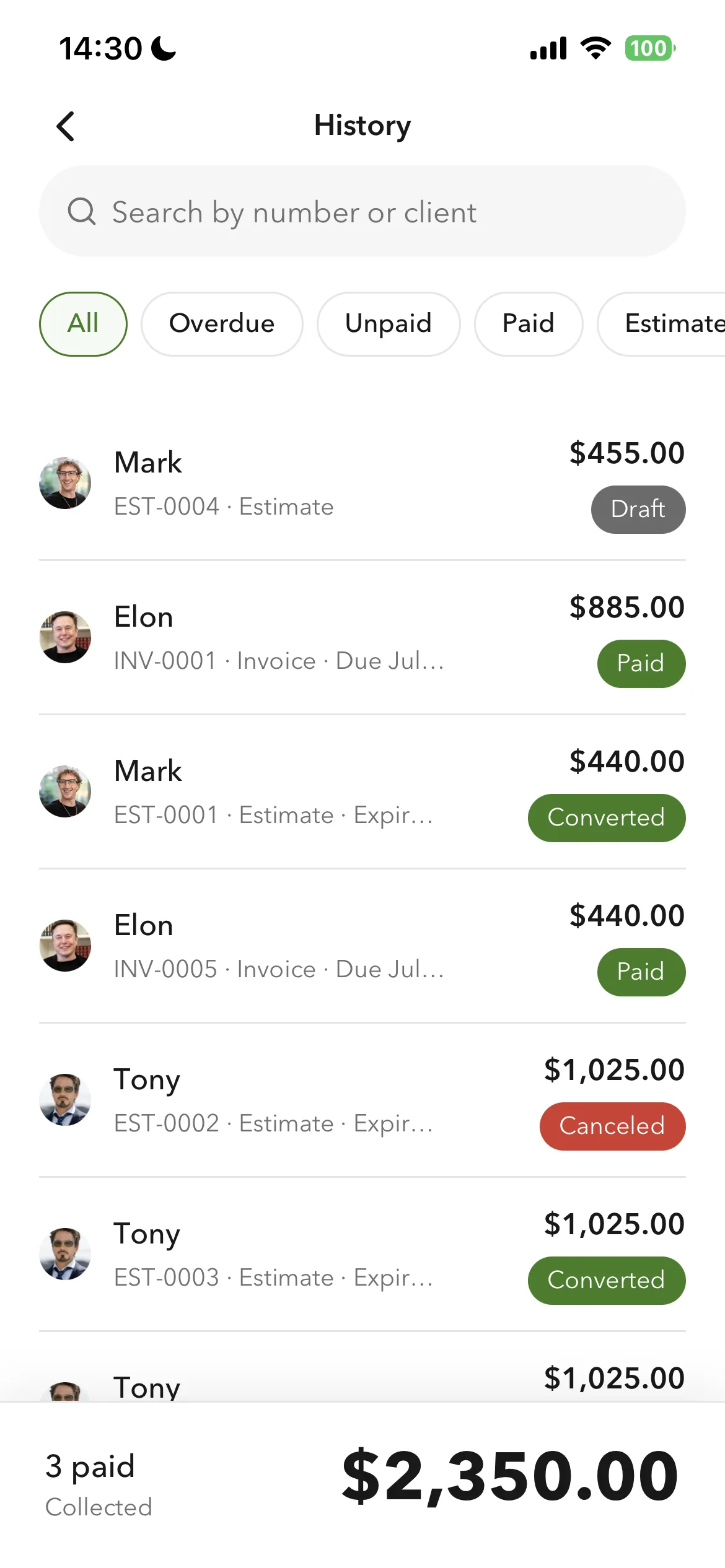
Billgami invoice history with paid, unpaid, and partial status on iPhone